Journal of International Obstetrics and Gynecology ›› 2026, Vol. 53 ›› Issue (4): 438-441.doi: 10.12280/gjfckx.20251391

• Gynecological Disease & Related Research:Original Article • Previous Articles     Next Articles

Clinical Study on the Jiman Double-Ring Fixation Technique for Preventing Mirena Expulsion in Patients with Adenomyosis and Enlarged Uterine Cavity

JIANG Qian-ying, ZHAO Shao-jie, TANG Yan()   

  1. Department of Gynecology, Wuxi Maternity and Child Health Care Hospital, Affiliated Women's Hospital of Jiangnan University, Wuxi 214000, Jiangsu Province, China
  • Received:2025-12-08 Published:2026-08-15 Online:2026-08-25
  • Contact: TANG Yan E-mail:yyj17270@163.com

Abstract:

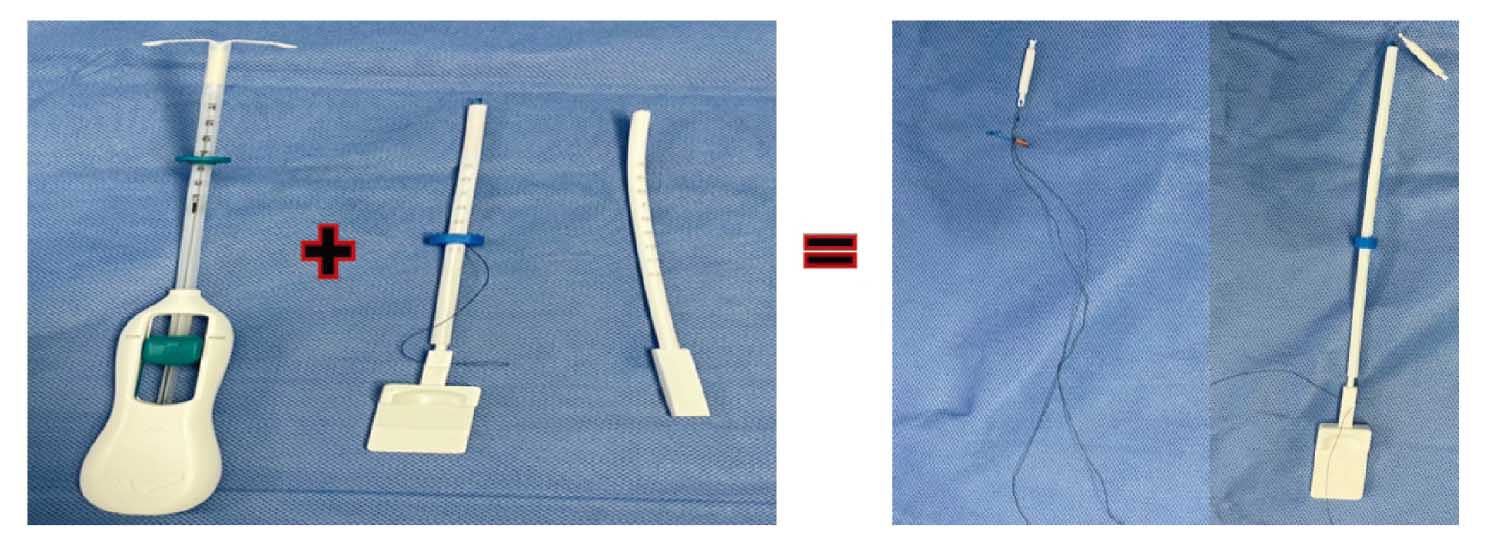
Objective: To explore the application value of the Jiman double-ring fixation technique in patients with adenomyosis and enlarged uterine cavity who have a history of Mirena displacement or expulsion, and to evaluate its effectiveness and safety in reducing the recurrence of Mirena displacement/expulsion and improving clinical symptoms. Methods: Clinical data of 50 patients with adenomyosis who underwent Jiman double-ring fixation procedure at our hospital from January 2023 to June 2024 were retrospectively analyzed. The surgical technique involved anchoring the uterine myometrium with GyneFix to simultaneously secure the Mirena intrauterine system. Intraoperative real-time ultrasound monitoring was used to assess the safe placement of the Jiman double-ring. Postoperative follow-up was conducted for 12 months, during which the position of the Jiman double-ring, pictorial blood loss assessment chart (PBAC) scores, visual analogue scale (VAS) scores, and complications were recorded. Results: All 50 enrolled patients with adenomyosis successfully underwent the Jiman double-ring fixation procedure under ultrasound guidance. The average operative time was (12.6±3.1) minutes, and the average intraoperative blood loss was (4.8±1.5) mL. No severe intraoperative complications such as uterine perforation, major hemorrhage, or infection were observed. The expulsion rate of Mirena was 0%, and the displacement rate was 4.0% (2 cases of mild displacement without affecting efficacy). The preoperative PBAC score was (215.6±42.8) points. Postoperative PBAC scores at 3, 6, and 12 months were (92.3±21.5) points, (65.1±18.7) points, and (52.6±15.3) points, respectively. The preoperative VAS score was (7.3±1.5) points. Postoperative VAS scores at 3, 6, and 12 months were (4.2±1.3) points, (2.8±0.9) points, and (1.6±0.7) points, respectively. The differences between scores at all follow-up time points and preoperative scores were statistically significant (all P<0.001). The main postoperative adverse reaction was intermenstrual spotting within the first 3 months, which did not significantly affect daily life, with an incidence of 52.0%. No severe adverse reactions occurred. Conclusions: Utilizing the principle of synergistic anchoring and fixation, the Jiman double-ring fixation technique significantly reduces the expulsion and displacement rates of Mirena in patients with adenomyosis and an enlarged uterine cavity. Postoperatively, satisfactory hemostatic effects and significant relief of dysmenorrhea symptoms can also be achieved. This technique is simple and safe, offering a new method for clinically addressing the challenge of easy displacement and expulsion of Mirena.

Key words: Intrauterine devices, medicated, Intrauterine devices, copper, Intrauterine device migration, Intrauterine device expulsion, Adenomyosis, Enlarged uterine cavity, Jiman double-ring fixation