
Journal of International Obstetrics and Gynecology ›› 2026, Vol. 53 ›› Issue (4): 390-396.doi: 10.12280/gjfckx.20260116
• Research on Gynecological Malignancies:Original Article • Previous Articles Next Articles
WANG Shu-jun, JING Li( )
)
Received:2026-02-06
Published:2026-08-15
Online:2026-08-25
Contact:
JING Li
E-mail:Ji771821@163.com
WANG Shu-jun, JING Li. Mechanism of miR-125b Reversing Cisplatin Resistance in Cervical Cancer SiHa Cells by Targeting BCL-2[J]. Journal of International Obstetrics and Gynecology, 2026, 53(4): 390-396.
Add to citation manager EndNote|Ris|BibTeX
| 组别 | n | miR-125b相对表达量 |
|---|---|---|
| SiHa组 | 3 | 1.00±0.10 |
| SiHa/DDP组 | 3 | 0.43±0.04a |
| SiHa+mimic-miR-125b组 | 3 | 1.23±0.13ab |
| SiHa/DDP+mimic-miR-125b组 | 3 | 0.65±0.06bc |
| F | 457.511 | |
| P | <0.001 |
| 组别 | n | miR-125b相对表达量 |
|---|---|---|
| SiHa组 | 3 | 1.00±0.10 |
| SiHa/DDP组 | 3 | 0.43±0.04a |
| SiHa+mimic-miR-125b组 | 3 | 1.23±0.13ab |
| SiHa/DDP+mimic-miR-125b组 | 3 | 0.65±0.06bc |
| F | 457.511 | |
| P | <0.001 |
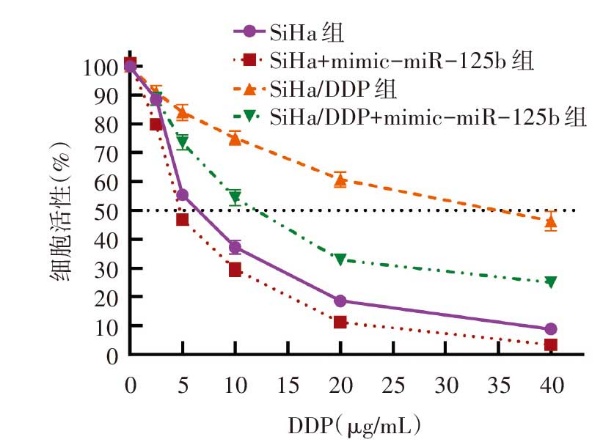
| 组别 | n | DDP(μg/mL) | F | P | IC50 | |||||
|---|---|---|---|---|---|---|---|---|---|---|
| 0 | 2.5 | 5 | 10 | 20 | 40 | |||||
| SiHa组 | 3 | 99.91±1.09 | 88.50±3.22* | 55.35±1.84* | 37.22±2.52* | 18.60±1.12* | 8.81±4.21* | 48.271 | <0.001 | 7.21 |
| SiHa+mimic-miR-125b组 | 3 | 101.13±1.03 | 79.80±2.15a* | 46.74±1.75a* | 29.51±2.31a* | 11.14±0.96a* | 3.35±3.87a* | 41.362 | <0.001 | 5.13 |
| SiHa/DDP组 | 3 | 99.94±1.16 | 91.06±3.28a* | 84.00±2.76a* | 75.16±2.59a* | 60.78±2.61a* | 46.37±3.48a* | 21.291 | <0.001 | 34.75 |
| SiHa/DDP+mimic-miR-125b组 | 3 | 99.87±0.95 | 88.70±3.20b* | 73.51±2.59b* | 54.38±2.67b* | 32.73±2.03b* | 24.95±1.59b* | 61.758 | <0.001 | 12.26 |
| F | 1.001 | 152.294 | 165.580 | 193.061 | 438.746 | 265.557 | ||||
| P | 0.441 | <0.001 | <0.001 | <0.001 | <0.001 | <0.001 | ||||
| 组别 | n | DDP(μg/mL) | F | P | IC50 | |||||
|---|---|---|---|---|---|---|---|---|---|---|
| 0 | 2.5 | 5 | 10 | 20 | 40 | |||||
| SiHa组 | 3 | 99.91±1.09 | 88.50±3.22* | 55.35±1.84* | 37.22±2.52* | 18.60±1.12* | 8.81±4.21* | 48.271 | <0.001 | 7.21 |
| SiHa+mimic-miR-125b组 | 3 | 101.13±1.03 | 79.80±2.15a* | 46.74±1.75a* | 29.51±2.31a* | 11.14±0.96a* | 3.35±3.87a* | 41.362 | <0.001 | 5.13 |
| SiHa/DDP组 | 3 | 99.94±1.16 | 91.06±3.28a* | 84.00±2.76a* | 75.16±2.59a* | 60.78±2.61a* | 46.37±3.48a* | 21.291 | <0.001 | 34.75 |
| SiHa/DDP+mimic-miR-125b组 | 3 | 99.87±0.95 | 88.70±3.20b* | 73.51±2.59b* | 54.38±2.67b* | 32.73±2.03b* | 24.95±1.59b* | 61.758 | <0.001 | 12.26 |
| F | 1.001 | 152.294 | 165.580 | 193.061 | 438.746 | 265.557 | ||||
| P | 0.441 | <0.001 | <0.001 | <0.001 | <0.001 | <0.001 | ||||
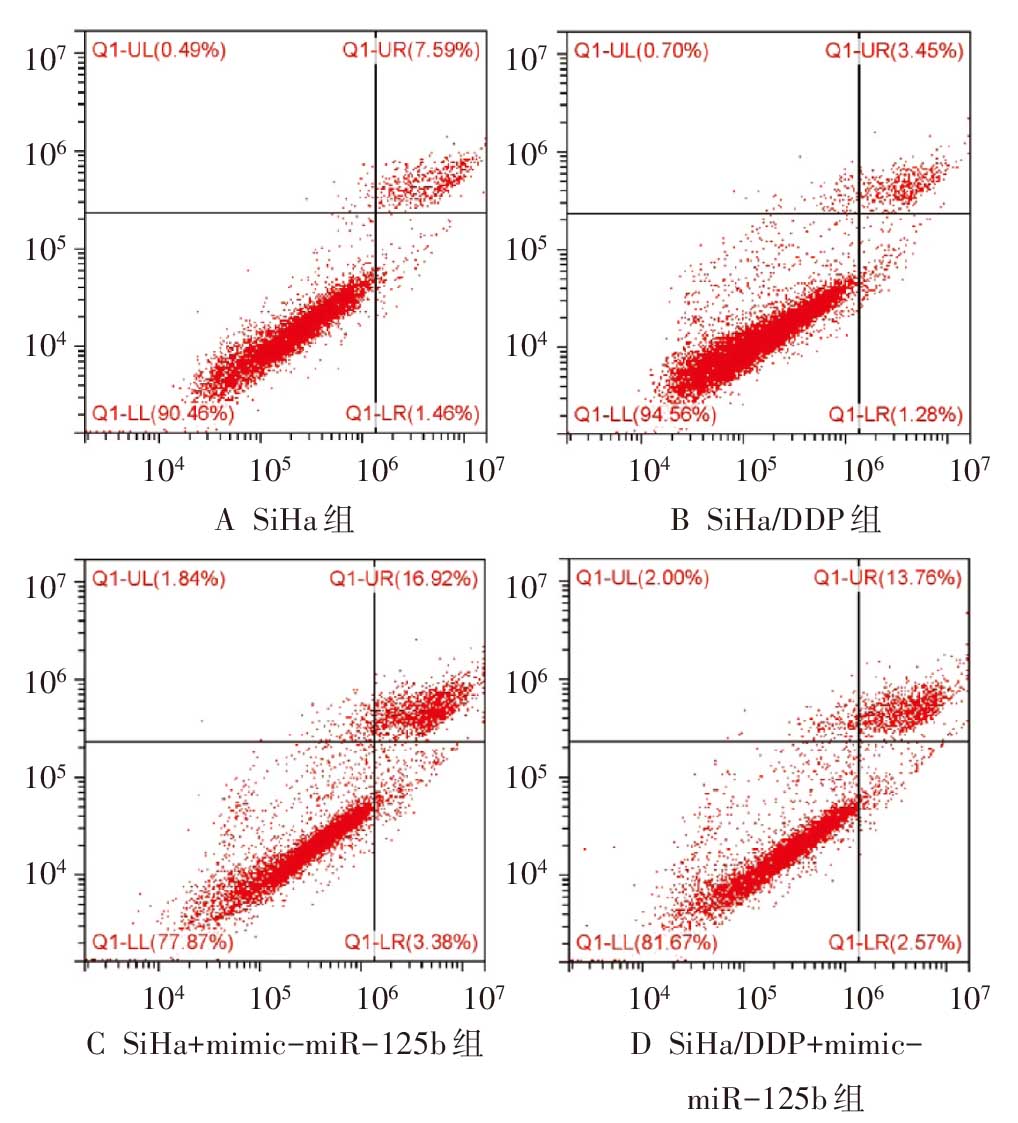
| 组别 | n | 细胞凋亡率 |
|---|---|---|
| SiHa组 | 3 | 9.04±1.03 |
| SiHa/DDP组 | 3 | 4.71±0.89a |
| SiHa+mimic-miR-125b组 | 3 | 20.33±2.07a |
| SiHa/DDP+mimic-miR-125b组 | 3 | 16.32±1.79bc |
| F | 63.591 | |
| P | <0.001 |
| 组别 | n | 细胞凋亡率 |
|---|---|---|
| SiHa组 | 3 | 9.04±1.03 |
| SiHa/DDP组 | 3 | 4.71±0.89a |
| SiHa+mimic-miR-125b组 | 3 | 20.33±2.07a |
| SiHa/DDP+mimic-miR-125b组 | 3 | 16.32±1.79bc |
| F | 63.591 | |
| P | <0.001 |
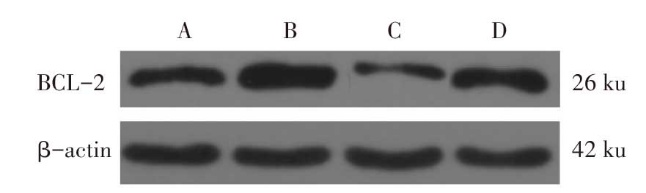
| 组别 | n | BCL-2 |
|---|---|---|
| SiHa组 | 3 | 0.79±0.08 |
| SiHa/DDP组 | 3 | 1.45±0.09a |
| SiHa+mimic-miR-125b组 | 3 | 0.46±0.09ab |
| SiHa/DDP+mimic-miR-125b组 | 3 | 1.09±0.10bc |
| F | 79.300 | |
| P | <0.001 |
| 组别 | n | BCL-2 |
|---|---|---|
| SiHa组 | 3 | 0.79±0.08 |
| SiHa/DDP组 | 3 | 1.45±0.09a |
| SiHa+mimic-miR-125b组 | 3 | 0.46±0.09ab |
| SiHa/DDP+mimic-miR-125b组 | 3 | 1.09±0.10bc |
| F | 79.300 | |
| P | <0.001 |
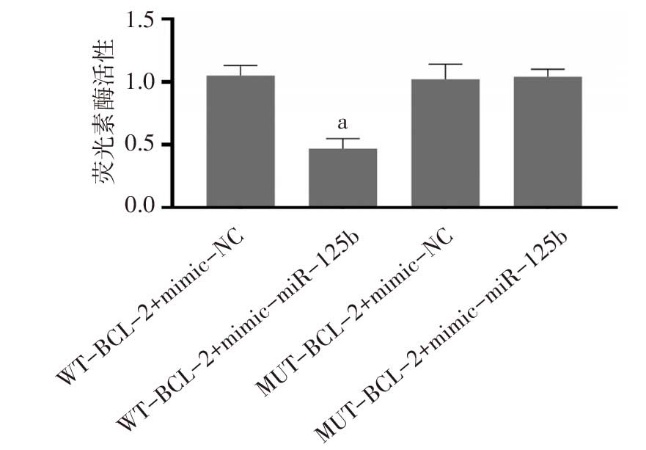
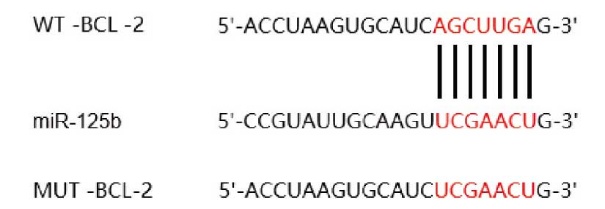
| 组别 | n | 荧光素酶活性 |
|---|---|---|
| WT-BCL-2+mimic-NC组 | 3 | 1.04±0.03 |
| WT-BCL-2+mimic-miR-125b组 | 3 | 0.47±0.03a |
| MUT-BCL-2+mimic-NC组 | 3 | 1.02±0.05 |
| MUT-BCL-2+mimic-miR-125b组 | 3 | 1.03±0.02 |
| F | 200.342 | |
| P | <0.001 |
| 组别 | n | 荧光素酶活性 |
|---|---|---|
| WT-BCL-2+mimic-NC组 | 3 | 1.04±0.03 |
| WT-BCL-2+mimic-miR-125b组 | 3 | 0.47±0.03a |
| MUT-BCL-2+mimic-NC组 | 3 | 1.02±0.05 |
| MUT-BCL-2+mimic-miR-125b组 | 3 | 1.03±0.02 |
| F | 200.342 | |
| P | <0.001 |
| [1] |
Li Z, Liu P, Yin A, et al. Global landscape of cervical cancer incidence and mortality in 2022 and predictions to 2030: The urgent need to address inequalities in cervical cancer[J]. Int J Cancer, 2025, 157(2):288-297. doi: 10.1002/ijc.35369.
pmid: 40026066 |
| [2] | Mukherjee A, Manna S, Singh A, et al. Investigating Cisplatin Resistance in Squamous Cervical Cancer: Proteomic Insights into DNA Repair Pathways and Omics-Based Drug Repurposing[J]. J Proteome Res, 2025, 24(6):2628-2642. doi: 10.1021/acs.jproteome.4c00885. |
| [3] | Wang B, Li L, Wu Z, et al. Long noncoding RNA UCA1 knockdown inhibits cisplatin-resistant cervical cancer tumorigenesis via the miR-195-5p/IKBKB axis[J]. Acta Biochim Biophys Sin(Shanghai), 2025, 57(9):1492-1506. doi: 10.3724/abbs.2025032. |
| [4] | Wang H, Yang Y, Zhang E, et al. LncRNA PGM5-AS1 Impairs the Resistance of Cervical Cancer to Cisplatin by Regulating the Hippo and PI3K-AKT Pathways[J]. Biochem Genet, 2025, 63(6):5641-5655. doi: 10.1007/s10528-024-11011-0. |
| [5] | Tang L, Wang Y, Chen Y, et al. LncRNA MIR17HG drives cisplatin resistance partially via miR-138-5p/AKAP9 axis in cholangiocarcinoma[J]. Scand J Gastroenterol, 2025, 60(2):184-196. doi: 10.1080/00365521.2025.2450024. |
| [6] | Kazmierczak D, Jopek K, Sterzynska K, et al. The Profile of MicroRNA Expression and Potential Role in the Regulation of Drug-Resistant Genes in Cisplatin-and Paclitaxel-Resistant Ovarian Cancer Cell Lines[J]. Int J Mol Sci, 2022, 23(1):526. doi: 10.3390/ijms23010526. |
| [7] |
Tan Q, Ma J, Zhang H, et al. miR-125b-5p upregulation by TRIM28 induces cisplatin resistance in non-small cell lung cancer through CREB1 inhibition[J]. BMC Pulm Med, 2022, 22(1):469. doi: 10.1186/s12890-022-02272-9.
pmid: 36476351 |
| [8] | Deng P, Sun M, Zhao WY, et al. Circular RNA circVAPA promotes chemotherapy drug resistance in gastric cancer progression by regulating miR-125b-5p/STAT3 axis[J]. World J Gastroenterol, 2021, 27(6):487-500. doi: 10.3748/wjg.v27.i6.487. |
| [9] | Hiruma K, Bilim V, Kazama A, et al. Acidic Microenvironment Enhances Cisplatin Resistance in Bladder Cancer via Bcl-2 and XIAP[J]. Curr Issues Mol Biol, 2025, 47(1):43. doi: 10.3390/cimb47010043. |
| [10] | Wang L, Xi C, Liu R, et al. Dual targeting of Mcl-1 and Bcl-2 to overcome chemoresistance in cervical and colon cancer[J]. Anticancer Drugs, 2024, 35(3):219-226. doi: 10.1097/CAD.0000000000001553. |
| [11] | 余琴, 刘艳, 柯娟, 等. 槲皮素对宫颈癌Hela/DDP细胞顺铂耐药性的影响及作用机制研究[J]. 河北中医, 2025, 47(3):456-460,467. doi: 10.3969/j.issn.1002-2619.2025.03.022. |
| [12] | Lin Y, Liu YQ, Zhu KA, et al. Tasquinimod enhances the sensitivity of ovarian cancer cells to cisplatin by regulating the Nur77-Bcl-2 apoptotic pathway[J]. Adv Clin Exp Med, 2024, 33(2):151-161. doi: 10.17219/acem/166044. |
| [13] |
Liu L, Guo NA, Li X, et al. miR-125b reverses cisplatin resistance by regulating autophagy via targeting RORA/BNIP3L axis in lung adenocarcinoma[J]. Oncol Res, 2024, 32(4):643-658. doi: 10.32604/or.2023.044491.
pmid: 38560570 |
| [14] | Liu YC, Liu SY, Lin YC, et al. The disruption of NEAT1-miR-125b-5p-SLC1A5 cascade defines the oncogenicity and differential immune profile in head and neck squamous cell carcinoma[J]. Cell Death Discov, 2024, 10(1):392. doi: 10.1038/s41420-024-02158-1. |
| [15] | Arribas AJ, Napoli S, Cascione L, et al. Resistance to PI3Kδ inhibitors in marginal zone lymphoma can be reverted by targeting the IL-6/PDGFRA axis[J]. Haematologica, 2022, 107(11):2685-2697. doi: 10.3324/haematol.2021.279957. |
| [16] |
Li W, Nie A, Jin L, et al. Long non-coding RNA terminal differentiation-induced non-coding RNA regulates cisplatin resistance of choroidal melanoma by positively modulating extracellular signal-regulated kinase 2 via sponging microRNA-19b-3p[J]. Bioengineered, 2022, 13(2):3422-3433. doi: 10.1080/21655979.2021.2014618.
pmid: 35067169 |
| [17] | Zhao Z, Wu Q, Xu Y, et al. Groenlandicine enhances cisplatin sensitivity in cisplatin-resistant osteosarcoma cells through the BAX/Bcl-2/Caspase-9/Caspase-3 pathway[J]. J Bone Oncol, 2024, 48:100631. doi: 10.1016/j.jbo.2024.100631. |
| [18] | 张天旭, 熊晓妹, 邹雪, 等. 蛇葡萄素通过调控Beclin-1/Bcl-2靶点对人宫颈癌SiHa细胞噬与凋亡的影响[J]. 中成药, 2024, 46(12):3977-3985. doi: 10.3969/j.issn.1001-1528.2024.12.012. |
| [19] | 吕飞飞, 李昆珊, 胡燕, 等. circVAPA通过miR-125b/HOXA7轴逆转口腔癌细胞化疗耐药的机制研究[J]. 现代肿瘤医学, 2023, 31(8):1398-1404. doi: 10.3969/j.issn.1672-4992.2023.08.004. |
| [20] | 王剑, 孙永东, 周兴玮, 等. 黄芩素经由miR-125b-5p/IRF4轴进而促进喉癌细胞死亡并抑制其侵袭的机制研究[J]. 中国临床药理学与治疗学, 2023, 28(11):1209-1218. doi: 10.12092/j.issn.1009-2501.2023.11.002. |
| [21] | 智慧, 朱伟, 王同杉, 等. miR-125b靶向抑制BCL2、MCL1表达对胃癌SGC7901/VCR细胞多药耐药性的影响[J]. 南京医科大学学报(自然科学版), 2011, 31(6):777-782. |
| [22] |
Liu X, Su L, Xu B, et al. Overexpression of long non-coding RNA NEAT1 enhances cell viability and inhibits apoptosis in recurrent spontaneous abortion by targeting the miR-125b/BCL-2 axis[J]. Exp Ther Med, 2022, 23(6):392. doi: 10.3892/etm.2022.11319.
pmid: 35495596 |
| [1] | DING Yue, LIU Yu, ZHANG Xiu-xia, LI Hong-li, LIU Chang. Research Progress on m6A Demethylase ALKBH5 in Gynecological Tumors [J]. Journal of International Obstetrics and Gynecology, 2026, 53(4): 361-366. |
| [2] | DENG Yuan-yuan, RUAN Xiao-hong, ZHANG Xin, WEI Ji-hong. Advances in the Application of Multimodal Models in the Diagnosis and Treatment of Endometrial Cancer [J]. Journal of International Obstetrics and Gynecology, 2026, 53(4): 374-378. |
| [3] | XIONG Yuan-yuan, ZHOU Zun-lun. Primary Tumors in Transposed Ovaries after Cervical Cancer Surgery: A Report of Two Cases [J]. Journal of International Obstetrics and Gynecology, 2026, 53(4): 397-401. |
| [4] | CHEN Si-qi, CHEN You-guo, ZHOU Jin-hua, DING Hong-mei, SHI Xiu, MA Jing-jing, WANG Jia-xue, NI Xiao-yan, LI Si-yu. Vulvar Metastasis as the Initial Presentation of Widespread Recurrent High-Grade Serous Ovarian Carcinoma: A Case Report [J]. Journal of International Obstetrics and Gynecology, 2026, 53(4): 402-405. |
| [5] | HANG Yu-jie, OU Si-yi, GAO Shan. Research Progress on Potential Biomarkers and Targets for Pelvic Organ Prolapse [J]. Journal of International Obstetrics and Gynecology, 2026, 53(4): 418-423. |
| [6] | HE Qian-nan, HUANG Zi-jie, WANG Yi-fan, AN Yu-sheng, FENG Shu-xian. Research Progress on Dual-Gene Methylation Testing of PAX1/JAM3 in Management of Cervical Lesion [J]. Journal of International Obstetrics and Gynecology, 2026, 53(3): 278-284. |
| [7] | XIANG Xiao-ying, SUN Ya-ge, ZHANG Yun-feng, JIA Han, WANG Yue. Research Advances in the Immune Microenvironment and Immunotherapy for p53-Abnormal Endometrial Carcinoma [J]. Journal of International Obstetrics and Gynecology, 2026, 53(3): 285-291. |
| [8] | WANG Wei, DAI Bai, SHA Ri-na, TUO Ya. Analysis of the Role and Molecular Subtype Association of Kinesin Family Member 18B in Endometrial Carcinoma [J]. Journal of International Obstetrics and Gynecology, 2026, 53(3): 292-297. |
| [9] | WU Hua-tuo, HUANG Chun-lin, MA Yan, GE Ting, LI Li. Research Progress on the Immune Microenvironment of Ovarian Cancer [J]. Journal of International Obstetrics and Gynecology, 2026, 53(3): 297-301. |
| [10] | YIN Di-shuang, LI Nan, GUO Hong-xia. Collision Tumor Composed of High-Grade Endometrial Stromal Sarcoma and Endometrioid Adenocarcinoma: A Case Report [J]. Journal of International Obstetrics and Gynecology, 2026, 53(3): 311-317. |
| [11] | LIU Er-yu, REN Qing-yu, GAO Xiang. A Case of Recurrent Cervical Cancer with Vesicoenteric Fistula [J]. Journal of International Obstetrics and Gynecology, 2026, 53(3): 322-328. |
| [12] | XU Meng-ting, LU Di, SONG Dian-rong. Research Progress in the Tumor Microenvironment of Ovarian Cancer [J]. Journal of International Obstetrics and Gynecology, 2026, 53(2): 188-193. |
| [13] | WEI Lin-yuan, PAN Zhong-mian, LI Li. Research Progress and Perspectives of Centrin 2 in Promoting Platinum Resistance in Epithelial Ovarian Cancer through Regulation of DNA Damage Repair [J]. Journal of International Obstetrics and Gynecology, 2026, 53(2): 194-199. |
| [14] | WANG Bing-yan, LI Feng-hu. Research Progress on the Reproductive Tract Microbiome in Cervical Cancer [J]. Journal of International Obstetrics and Gynecology, 2026, 53(2): 200-205. |
| [15] | ZHANG Yan, SONG Shu-fang. Advances in the Application of DNA Methylation in Cervical Lesions [J]. Journal of International Obstetrics and Gynecology, 2026, 53(2): 206-210. |
| Viewed | ||||||
|
Full text |
|
|||||
|
Abstract |
|
|||||
