
Journal of International Obstetrics and Gynecology ›› 2026, Vol. 53 ›› Issue (5): 579-586.doi: 10.12280/gjfckx.20260061
• Research on Gynecological Malignancies:Original Article • Previous Articles Next Articles
FENG Shu-jie, CHEN Jiao, LI Yang-xi( )
Received:2026-01-23
Published:2026-10-15
Online:2026-10-26
Contact:
LI Yang-xi, E-mail: liyangxi2025@163.com
FENG Shu-jie, CHEN Jiao, LI Yang-xi. Burden and Forecast of Ovarian Cancer in China and Globally from 1990 to 2023[J]. Journal of International Obstetrics and Gynecology, 2026, 53(5): 579-586.
Add to citation manager EndNote|Ris|BibTeX
| 指标 | 中国 | 全球 | ||||
|---|---|---|---|---|---|---|
| 1990年(1/10万,95%UI) | 2023年(1/10万,95%UI) | 变化率(%) | 1990年(1/10万,95%UI) | 2023年(1/10万,95%UI) | 变化率(%) | |
| ASIR | 4.73(3.58~6.07) | 3.66(3.05~4.38) | -22.60 | 7.14(6.49~7.92) | 7.33(6.30~8.79) | 2.70 |
| ASPR | 20.08(14.51~26.01) | 17.77(14.46~21.77) | -11.52 | 28.02(24.67~32.24) | 31.09(25.68~37.92) | 11.00 |
| ASMR | 2.98(2.22~3.90) | 2.04(1.67~2.48) | -31.58 | 4.94(4.49~5.42) | 4.63(4.00~5.36) | -6.38 |
| ASDR | 99.83(74.23~129.35) | 62.35(51.81~75.23) | -37.55 | 142.33(128.14~158.45) | 140.60(118.22~166.98) | -19.30 |
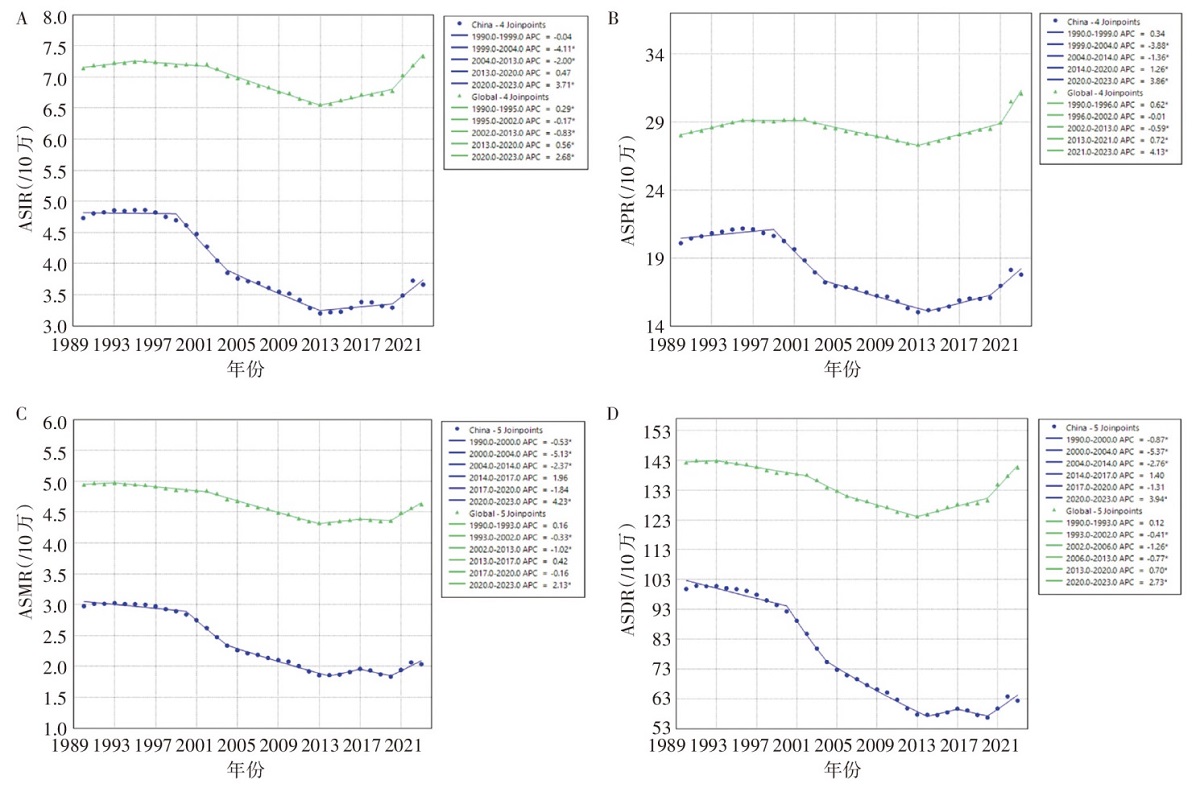
| 地区 | ASIR | ASPR | ASMR | ASDR | ||||
|---|---|---|---|---|---|---|---|---|
| AAPC | 95%CI | AAPC | 95%CI | AAPC | 95%CI | AAPC | 95%CI | |
| 中国 | -0.77* | -1.07~-0.46 | -0.35* | -0.64~-0.06 | -1.14* | -1.62~-0.65 | -1.41* | -1.94~-0.88 |
| 全球 | 0.09* | 0.01~0.17 | 0.33* | 0.26~0.41 | -0.19* | -0.31~-0.06 | -0.02 | -0.12~-0.07 |
| 地区 | 指标 | 总差异 | 人口学因素所致变化(占总变化百分比) | ||
|---|---|---|---|---|---|
| 人口老龄化 | 人口增长 | 流行病学变化 | |||
| 中国 | 发病人数(例) | 14 878.44 | 16 429.88(110.43%) | 6 274.05(42.17%) | -7 825.50(-52.60%) |
| 患病人数(例) | 62 976.67 | 45 714.99(72.59%) | 30 613.21(48.61%) | -13 351.52(-21.20%) | |
| 死亡人数(例) | 11 741.94 | 13 102.20(111.58%) | 7 127.50(60.70%) | -8 487.76(-72.29%) | |
| DALY数(人年) | 172 361.22 | 331 945.54(192.59%) | 138 526.09(80.37%) | -298 110.41(-172.96%) | |
| 全球 | 发病人数(例) | 180 212.33 | 75 583.28(41.94%) | 98 908.24(54.88%) | 5 720.80(3.17%) |
| 患病人数(例) | 754 407.39 | 250 762.23(33.24%) | 403 057.65(53.43%) | 100 587.51(13.33%) | |
| 死亡人数(例) | 187 714.79 | 89 569.49(47.72%) | 127 993.63(68.19%) | -29 848.33(-15.90%) | |
| DALY数(人年) | 3 313 332.21 | 1 456 364.18(43.95%) | 1 929 216.12(58.23%) | -72 248.09(-2.18%) | |
| [1] | 曹瑢, 陈刚. 卵巢恶性肿瘤随访[J]. 中国实用妇科与产科杂志, 2024, 40(11):1091-1093. doi: 10.19538/j.fk2024110109. |
| [2] | Bray F, Laversanne M, Sung H, et al. Global cancer statistics 2022: GLOBOCAN estimates of incidence and mortality worldwide for 36 cancers in 185 countries[J]. CA Cancer J Clin, 2024, 74(3):229-263. doi: 10.3322/caac.21834. |
| [3] |
Menon U, Gentry-Maharaj A, Burnell M, et al. Ovarian cancer population screening and mortality after long-term follow-up in the UK Collaborative Trial of Ovarian Cancer Screening (UKCTOCS): a randomised controlled trial[J]. Lancet, 2021, 397(10290):2182-2193. doi: 10.1016/S0140-6736(21)00731-5.
pmid: 33991479 |
| [4] | Menon U, Gentry-Maharaj A, Burnell M, et al. Tumour stage, treatment, and survival of women with high-grade serous tubo-ovarian cancer in UKCTOCS: an exploratory analysis of a randomised controlled trial[J]. Lancet Oncol, 2023, 24(9):1018-1028. doi: 10.1016/S1470-2045(23)00335-2. |
| [5] | 中国老年保健协会妇科肿瘤专业委员会, 中国医师协会妇产科医师分会, 沈杨. 卵巢癌早期筛查中国专家共识(2025年版)[J]. 中国实用妇科与产科杂志, 2025, 41(2):204-211. doi: 10.19538/j.fk2025020113. |
| [6] | Wang Z, Guo E, Yang B, et al. Trends and age-period-cohort effects on mortality of the three major gynecologic cancers in China from 1990 to 2019: Cervical, ovarian and uterine cancer[J]. Gynecol Oncol, 2021, 163(2):358-363. doi: 10.1016/j.ygyno.2021.08.029. |
| [7] | Kim HJ, Fay MP, Feuer EJ, et al. Permutation tests for joinpoint regression with applications to cancer rates[J]. Stat Med, 2000, 19(3):335-351. doi: 10.1002/(sici)1097-0258(20000215)19:3<335::aid-sim336>3.0.co;2-z. |
| [8] | Xu Q, Qiao Z, Kan Y, et al. Global, regional, and national burden of depression, 1990-2021: a decomposition and age-period-cohort analysis with projection to 2040[J]. J Affect Disord, 2025, 391:120018. doi: 10.1016/j.jad.2025.120018. |
| [9] | Zhou Z, Wang X, Ren X, et al. Disease Burden and Attributable Risk Factors of Ovarian Cancer From 1990 to 2017: Findings From the Global Burden of Disease Study 2017[J]. Front Public Health, 2021, 9:619581. doi: 10.3389/fpubh.2021.619581. |
| [10] | Huang M, Guan M, Rao Q, et al. Long-term trends and projections of ovarian cancer burden in China (1990 to 2040): an age-period-cohort analysis based on GBD 2021 data[J]. Front Oncol, 2025, 15:1652347. doi: 10.3389/fonc.2025.1652347. |
| [11] |
Zhang S, Cheng C, Lin Z, et al. The global burden and associated factors of ovarian cancer in 1990-2019: findings from the Global Burden of Disease Study 2019[J]. BMC Public Health, 2022, 22(1):1455. doi: 10.1186/s12889-022-13861-y.
pmid: 35907822 |
| [12] | Li T, Zhang H, Lian M, et al. Global status and attributable risk factors of breast, cervical, ovarian, and uterine cancers from 1990 to 2021[J]. J Hematol Oncol, 2025, 18(1):5. doi: 10.1186/s13045-025-01660-y. |
| [13] | Witzel I, Samartzis EP, El-Balat A. Progress in the treatment of ovarian cancer[J]. Praxis (Bern 1994), 2025, 114(2):56-60. doi: 10.23785/PRAXIS.2025.02.005. |
| [14] | Choe S, Jeon M, Yoon H. Advanced Therapeutic Approaches for Metastatic Ovarian Cancer[J]. Cancers(Basel), 2025, 17(5):788. doi: 10.3390/cancers17050788. |
| [15] | Xiong Z, Huang Y, Cao S, et al. A new strategy for the treatment of advanced ovarian cancer: utilizing nanotechnology to regulate the tumor microenvironment[J]. Front Immunol, 2025, 16:1542326. doi: 10.3389/fimmu.2025.1542326. |
| [16] | Wu Y, Fan L, Shao H, et al. Evaluation of a novel ensemble model for preoperative ovarian cancer diagnosis: Clinical factors, O-RADS, and deep learning radiomics[J]. Transl Oncol, 2025, 54:102335. doi: 10.1016/j.tranon.2025.102335. |
| [17] | Momenimovahed Z, Mazidimoradi A, Allahqoli L, et al. The Role of CA-125 in the Management of Ovarian Cancer: A Systematic Review[J]. Cancer Rep(Hoboken), 2025, 8(3):e70142. doi: 10.1002/cnr2.70142. |
| [18] | Wang Y, Wang Z, Zhang Z, et al. Burden of ovarian cancer in China from 1990 to 2030: A systematic analysis and comparison with the global level[J]. Front Public Health, 2023, 11:1136596. doi: 10.3389/fpubh.2023.1136596. |
| [19] |
Matz M, Coleman MP, Sant M, et al. The histology of ovarian cancer: worldwide distribution and implications for international survival comparisons (CONCORD-2)[J]. Gynecol Oncol, 2017, 144(2):405-413. doi: 10.1016/j.ygyno.2016.10.019.
pmid: 27931752 |
| [20] | Jemal A, Bray F, Center MM, et al. Global cancer statistics[J]. CA Cancer J Clin, 2011, 61(2):69-90. doi: 10.3322/caac.20107. |
| [21] |
Fang EF, Scheibye-Knudsen M, Jahn HJ, et al. A research agenda for aging in China in the 21st century[J]. Ageing Res Rev, 2015, 24(Pt B):197-205. doi: 10.1016/j.arr.2015.08.003.
pmid: 26304837 |
| [22] |
Chen B, Zhan Z, Fang W, et al. Long-term trends and future projections of larynx cancer burden in China: a comprehensive analysis from 1990 to 2030 using GBD data[J]. Sci Rep, 2024, 14(1):26523. doi: 10.1038/s41598-024-77797-6.
pmid: 39489769 |
| [23] | Kim EB, Jeon HY, Ouh YT, et al. Proinsulin C-peptide inhibits high glucose-induced migration and invasion of ovarian cancer cells[J]. Biomed Pharmacother, 2024, 172:116232. doi: 10.1016/j.biopha.2024.116232. |
| [24] | Wu P, Jiang Q, Han L, et al. Systematic analysis and prediction for disease burden of ovarian cancer attributable to hyperglycemia: a comparative study between China and the world from 1990 to 2019[J]. Front Med(Lausanne), 2023, 10:1145487. doi: 10.3389/fmed.2023.1145487. |
| [25] | Asbestos-related disease--a preventable burden[J]. Lancet, 2008, 372(9654):1927. doi: 10.1016/S0140-6736(08)61821-8. |
| [26] |
Delort L, Kwiatkowski F, Chalabi N, et al. Central adiposity as a major risk factor of ovarian cancer[J]. Anticancer Res, 2009, 29(12):5229-5234.
pmid: 20044641 |
| [27] | Zhang D, Li N, Xi Y, et al. Diabetes mellitus and risk of ovarian cancer. A systematic review and meta-analysis of 15 cohort studies[J]. Diabetes Res Clin Pract, 2017, 130:43-52. doi: 10.1016/j.diabres.2017.04.005. |
| [28] | Hu J, Wang J, Li Y, et al. Use of Dietary Fibers in Reducing the Risk of Several Cancer Types: An Umbrella Review[J]. Nutrients, 2023, 15(11):2545. doi: 10.3390/nu15112545. |
| [29] | Mueller PR, Kershner AJ, Breitrick BI, et al. Vitamin D and docosahexaenoic acid inhibit proliferation of the ovarian cancer cell line OVCAR4[J]. Nutr Health, 2025, 31(2):575-584. doi: 10.1177/02601060231202565. |
| [30] |
Husby A, Wohlfahrt J, Melbye M. Pregnancy duration and ovarian cancer risk: A 50-year nationwide cohort study[J]. Int J Cancer, 2022, 151(10):1717-1725. doi: 10.1002/ijc.34192.
pmid: 35751416 |
| [31] | 中华人民共和国中央人民政府. 中共中央国务院印发《“健康中国2030”规划纲要》[EB/OL].(2016-10-25)[2025-09-16]. https://www.gov.cn/zhengce/2016-10/25/content_5124174.htm. |
| [1] | YI Si-yu, WANG Fen. Role and Mechanism of Cytokeratin in Epithelial Ovarian Cancer [J]. Journal of International Obstetrics and Gynecology, 2026, 53(5): 551-555. |
| [2] | WAN Tao, TAO Yao, WANG Hou-mei, XIAO Zi-wen. Research Progress on the Mechanism of Acquired Resistance to Cisplatin and PARP Inhibitors in Epithelial Ovarian Cancer [J]. Journal of International Obstetrics and Gynecology, 2026, 53(5): 556-562. |
| [3] | ZHU Chen-xu, WANG Cai-zhu, SHEN Rong. Application of Non-Invasive Screening and Immune Assessment Biomarkers in the Comprehensive Management of Endometrial Carcinoma [J]. Journal of International Obstetrics and Gynecology, 2026, 53(5): 563-568. |
| [4] | LIU Xiao-yu, LU Xiu-rong, LI Ya-ru, ZHAO Wei-wei, ZHANG Fan, CHEN Jiang-ping. Impact and Predictive Value of Glycolipid Transfer Protein on the Prognosis of Patients with Locally Advanced Cervical Cancer Treated with Neoadjuvant Chemotherapy Combined with Immunotherapy Followed by Radiotherapy [J]. Journal of International Obstetrics and Gynecology, 2026, 53(5): 569-578. |
| [5] | SHEN Qing-li, YI Li-sha, SHI Quan, YUAN Li, AI Bin. Ipsilateral Ovarian Endometrioma Following Surgery for Mature Teratoma in An Adolescent Female: A Case Report [J]. Journal of International Obstetrics and Gynecology, 2026, 53(5): 597-600. |
| [6] | DING Jian-hua, LI Wei, WANG Huai-tao, LI Guang-ning, SUN Na, SHANG Ran, HAN Xiang-chun. Primary Ovarian Borderline Mucinous Adenofibroma with Mucinous Adenocarcinoma: A Case Report [J]. Journal of International Obstetrics and Gynecology, 2026, 53(5): 591-596. |
| [7] | DING Yue, LIU Yu, ZHANG Xiu-xia, LI Hong-li, LIU Chang. Research Progress on m6A Demethylase ALKBH5 in Gynecological Tumors [J]. Journal of International Obstetrics and Gynecology, 2026, 53(4): 361-366. |
| [8] | DENG Yuan-yuan, RUAN Xiao-hong, ZHANG Xin, WEI Ji-hong. Advances in the Application of Multimodal Models in the Diagnosis and Treatment of Endometrial Cancer [J]. Journal of International Obstetrics and Gynecology, 2026, 53(4): 374-378. |
| [9] | WANG Shu-jun, JING Li. Mechanism of miR-125b Reversing Cisplatin Resistance in Cervical Cancer SiHa Cells by Targeting BCL-2 [J]. Journal of International Obstetrics and Gynecology, 2026, 53(4): 390-396. |
| [10] | XIONG Yuan-yuan, ZHOU Zun-lun. Primary Tumors in Transposed Ovaries after Cervical Cancer Surgery: A Report of Two Cases [J]. Journal of International Obstetrics and Gynecology, 2026, 53(4): 397-401. |
| [11] | CHEN Si-qi, CHEN You-guo, ZHOU Jin-hua, DING Hong-mei, SHI Xiu, MA Jing-jing, WANG Jia-xue, NI Xiao-yan, LI Si-yu. Vulvar Metastasis as the Initial Presentation of Widespread Recurrent High-Grade Serous Ovarian Carcinoma: A Case Report [J]. Journal of International Obstetrics and Gynecology, 2026, 53(4): 402-405. |
| [12] | ZHU Xu-ran, CHEN Fei. Research Progress on Predicting Spontaneous Preterm Birth Using Ultrasound-Measured Cervical Parameters Combined with Biomarkers [J]. Journal of International Obstetrics and Gynecology, 2026, 53(4): 452-458. |
| [13] | HE Qian-nan, HUANG Zi-jie, WANG Yi-fan, AN Yu-sheng, FENG Shu-xian. Research Progress on Dual-Gene Methylation Testing of PAX1/JAM3 in Management of Cervical Lesion [J]. Journal of International Obstetrics and Gynecology, 2026, 53(3): 278-284. |
| [14] | XIANG Xiao-ying, SUN Ya-ge, ZHANG Yun-feng, JIA Han, WANG Yue. Research Advances in the Immune Microenvironment and Immunotherapy for p53-Abnormal Endometrial Carcinoma [J]. Journal of International Obstetrics and Gynecology, 2026, 53(3): 285-291. |
| [15] | WANG Wei, DAI Bai, SHA Ri-na, TUO Ya. Analysis of the Role and Molecular Subtype Association of Kinesin Family Member 18B in Endometrial Carcinoma [J]. Journal of International Obstetrics and Gynecology, 2026, 53(3): 292-297. |
| Viewed | ||||||
|
Full text |
|
|||||
|
Abstract |
|
|||||
