
国际妇产科学杂志 ›› 2026, Vol. 53 ›› Issue (3): 249-254.doi: 10.12280/gjfckx.20260100
娄颖亚, 高娟妹, 翟洪波( )
)
收稿日期:2026-02-05
出版日期:2026-06-15
发布日期:2026-07-06
通讯作者:
翟洪波
E-mail:zhaihb@126.com
基金资助:
LOU Ying-ya, GAO Juan-mei, ZHAI Hong-bo()
Received:2026-02-05
Published:2026-06-15
Online:2026-07-06
Contact:
ZHAI Hong-bo
E-mail:zhaihb@126.com
摘要:
双胎妊娠早产率为47.6%~69.0%,其中晚期早产率33.0%~59.8%,显著高于单胎妊娠。产前皮质类固醇(antenatal corticosteroids,ACS)在妊娠34周前使用能有效降低新生儿死亡等并发症,而在晚期早产中的应用存在争议,尤其在双胎妊娠中。多数研究支持ACS能降低双胎妊娠晚期早产儿发生呼吸窘迫综合征等呼吸系统并发症,但部分研究发现两者并无明确关联,且效果不及单胎妊娠。ACS对双胎妊娠晚期早产儿远期神经系统发育的影响尚未明确,部分证据提示可能增加认知发育延迟、注意力缺陷以及多动障碍等,动物实验也验证了ACS潜在神经损伤机制。同时ACS可增加双胎妊娠晚期早产儿低血糖风险,低血糖与远期神经发育异常也存在潜在关联。目前国内外指南对双胎妊娠晚期早产常规使用ACS缺乏共识,大多建议个体化决策。
娄颖亚, 高娟妹, 翟洪波. 皮质类固醇在双胎妊娠晚期早产中应用的研究进展[J]. 国际妇产科学杂志, 2026, 53(3): 249-254.
LOU Ying-ya, GAO Juan-mei, ZHAI Hong-bo. Research Progress on the Application of Corticosteroids in Late Preterm Twin Pregnancies[J]. Journal of International Obstetrics and Gynecology, 2026, 53(3): 249-254.
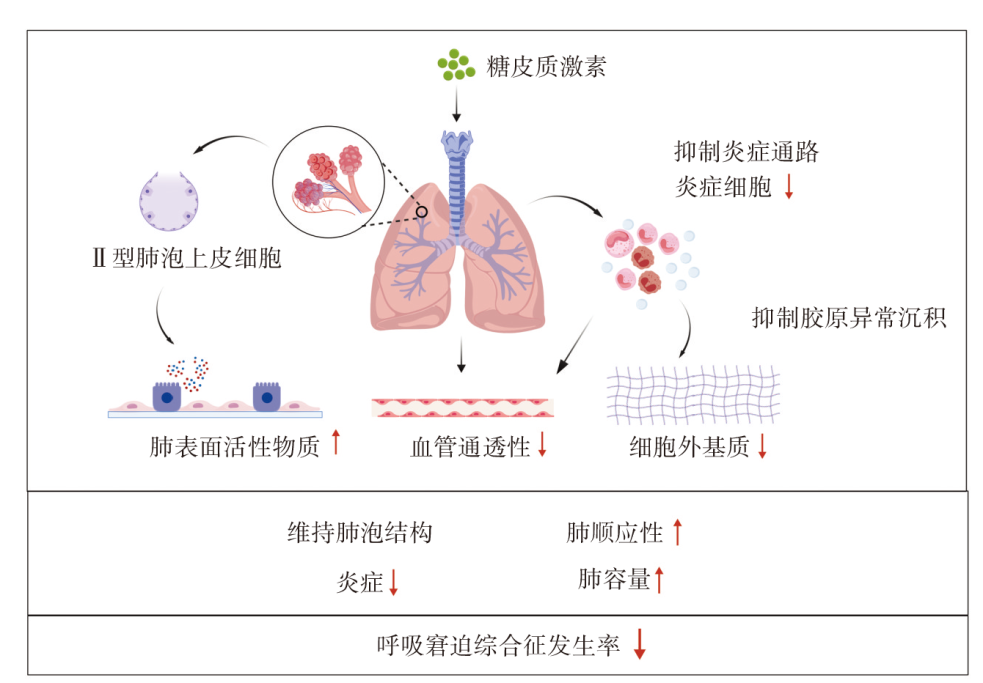
图1 ACS降低RDS发生的机制图 注:糖皮质激素可刺激Ⅱ型肺泡上皮细胞,上调表面活性物质的合成与分泌,从而稳定肺泡;糖皮质激素通过抑制炎症通路并调节细胞外基质及胶原蛋白基因表达;还可降低血管通透性,增加肺顺应性和最大肺容积,减轻肺部炎症与水肿。
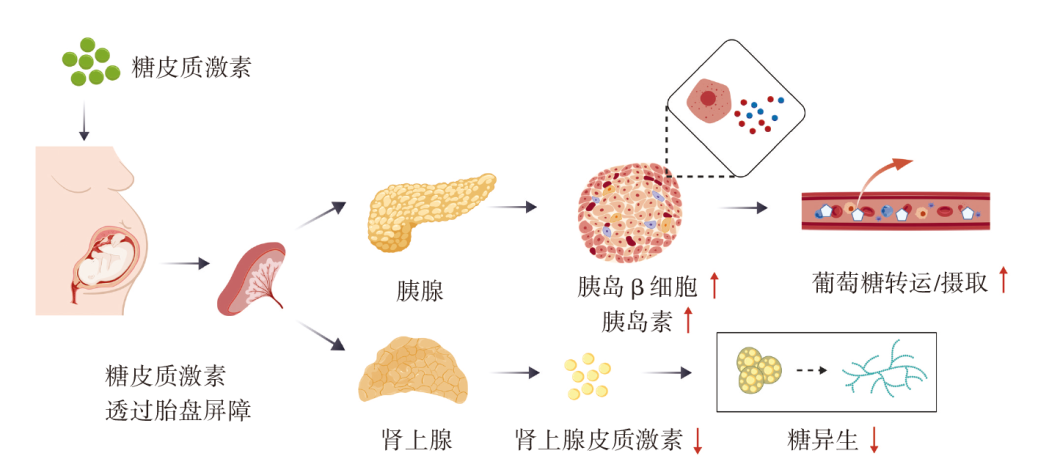
图2 ACS促使新生儿低血糖的机制图 注:糖皮质激素透过胎盘屏障,高血糖水平刺激胎儿胰岛β细胞增殖并引发高胰岛素血症,出生后,胎盘的葡萄糖供应突然中断,但胰岛素水平仍居高不下,促使葡萄糖进入组织,导致新生儿短暂性低血糖;其还可抑制胎儿肾上腺轴,抑制胎儿肾上腺皮质激素的合成与分泌,而肾上腺皮质激素具有促进糖异生、升高血糖的作用,其分泌不足会导致新生儿糖异生能力下降。
| [1] | 赵扬玉, 孟新璐, 吴天晨. 双胎妊娠管理的现状、挑战与展望[J]. 中国实用妇科与产科杂志, 2025, 41(2):129-132. doi: 10.19538/j.fk2025020101. |
| [2] | 中华医学会妇产科学分会产科学组. 早产临床防治指南(2024版)[J]. 中华妇产科杂志, 2024, 59(4):257-269. doi: 10.3760/cma.j.cn112141-20231119-00208. |
| [3] | Burger RJ, Temmink S, Wertaschnigg D, et al. Trends in preterm birth in twin pregnancies in Victoria, Australia, 2007-2017[J]. Aust N Z J Obstet Gynaecol, 2021, 61(1):55-62. doi: 10.1111/ajo.13227. |
| [4] | Isaacson A, Diseko M, Mayondi G, et al. Prevalence and outcomes of twin pregnancies in Botswana: a national birth outcomes surveillance study[J]. BMJ Open, 2021, 11(10):e047553. doi: 10.1136/bmjopen-2020-047553. |
| [5] | 李想, 富建华. 单胎与双胎早产儿的临床结局[J]. 中华新生儿科杂志(中英文), 2023, 38(10):637-640. doi: 10.3760/cma.j.issn.2096-2932.2023.10.015. |
| [6] |
Monari F, Chiossi G, Ballarini M, et al. Perinatal outcomes in twin late preterm pregnancies: results from an Italian area-based, prospective cohort study[J]. Ital J Pediatr, 2022, 48(1):101. doi: 10.1186/s13052-022-01297-4.
pmid: 35710441 |
| [7] | Li S, Gao J, Liu J, et al. Perinatal Outcomes and Risk Factors for Preterm Birth in Twin Pregnancies in a Chinese Population: A Multi-center Retrospective Study[J]. Front Med(Lausanne), 2021, 8:657862. doi: 10.3389/fmed.2021.657862. |
| [8] | Tingleff T, Räisänen S, Vikanes Å, et al. Different pathways for preterm birth between singleton and twin pregnancies: a population-based registry study of 481 176 nulliparous women[J]. BJOG, 2023, 130(4):387-395. doi: 10.1111/1471-0528.17344. |
| [9] | Arham M, Wróblewska-Seniuk K. Short- and Long-Term Consequences of Late-Preterm and Early-Term Birth[J]. Children(Basel), 2025, 12(7):907. doi: 10.3390/children12070907. |
| [10] | Roman A, Ramirez A, Fox NS. Prevention of preterm birth in twin pregnancies[J]. Am J Obstet Gynecol MFM, 2022, 4(2S):100551. doi: 10.1016/j.ajogmf.2021.100551. |
| [11] |
Salem SY, Kibel M, Asztalos E, et al. Neonatal Outcomes of Low-Risk, Late-Preterm Twins Compared With Late-Preterm Singletons[J]. Obstet Gynecol, 2017, 130(3):582-590. doi: 10.1097/AOG.0000000000002187.
pmid: 28796691 |
| [12] |
Marttila R, Kaprio J, Hallman M. Respiratory distress syndrome in twin infants compared with singletons[J]. Am J Obstet Gynecol, 2004, 191(1):271-276. doi: 10.1016/j.ajog.2003.11.020.
pmid: 15295378 |
| [13] | Ward C, Caughey AB. Late preterm births: neonatal mortality and morbidity in twins vs. singletons[J]. J Matern Fetal Neonatal Med, 2022, 35(25):7962-7967. doi: 10.1080/14767058.2021.1939303. |
| [14] |
You J, Shamsi BH, Hao MC, et al. A study on the neurodevelopment outcomes of late preterm infants[J]. BMC Neurol, 2019, 19(1):108. doi: 10.1186/s12883-019-1336-0.
pmid: 31146703 |
| [15] | Ruiz NM, García Íñiguez JP, Rite Gracia S, et al. Prospective study on influence of perinatal factors on the development of early neonatal hypoglycemia in late preterm and term infants[J]. An Pediatr(Engl Ed), 2022, 96(3):230-241. doi: 10.1016/j.anpede.2021.04.007. |
| [16] | Gente M, Papoff P, Luciani S, et al. Lung development in the late preterm[J]. Ital J Pediatr, 2014, 40(Suppl 2):A24. doi: 10.1186/1824-7288-40-S2-A24. |
| [17] | Cornette L, Mulder A, Debeer A, et al. Surfactant use in late preterm infants: a survey among Belgian neonatologists[J]. Eur J Pediatr, 2021, 180(3):885-892. doi: 10.1007/s00431-020-03806-1. |
| [18] | Schmidt AF, Kannan PS, Bridges J, et al. Prenatal inflammation enhances antenatal corticosteroid-induced fetal lung maturation[J]. JCI Insight, 2020, 5(24):e139452. doi: 10.1172/jci.insight.139452. |
| [19] | Lee SM, Park HS, Choi SR, et al. Antenatal Corticosteroid in Twin-Pregnant Women at Risk of Late Preterm Delivery: A Randomized Clinical Trial[J]. JAMA Pediatr, 2026, 179(12):1275-1282. doi: 10.1001/jamapediatrics.2025.3284. |
| [20] | Onishi K, Huang JC, Saade GR, et al. Post Antenatal Late Preterm Steroids trial: interrupted time series analysis of respiratory outcomes in twin and pregestational diabetes[J]. Am J Obstet Gynecol MFM, 2023, 5(8):101041. doi: 10.1016/j.ajogmf.2023.101041. |
| [21] |
Martinka D, Barrett J, Mei-Dan E, et al. Respiratory morbidity in late preterm twin infants[J]. Arch Gynecol Obstet, 2019, 300(2):337-345. doi: 10.1007/s00404-019-05191-z.
pmid: 31093740 |
| [22] | Zhu J, Zhao Y, An P, et al. Antenatal Corticosteroid Treatment During the Late-Preterm Period and Neonatal Outcomes for Twin Pregnancies[J]. JAMA Netw Open, 2023, 6(11):e2343781. doi: 10.1001/jamanetworkopen.2023.43781. |
| [23] | Dereli ML, Yücel KY, Topkara S, et al. Antenatal corticosteroid treatment after 34 weeks of gestation in twin pregnancies at high risk of late preterm delivery[J]. BMC Pregnancy Childbirth, 2025, 25(1):313. doi: 10.1186/s12884-025-07398-2. |
| [24] | Berger DS, Abbas DS, Marty LN, et al. Antenatal Corticosteroids and Neonatal Outcomes Among Patients With Twin Gestations at Risk for Late Preterm Birth[J]. Obstet Gynecol, 2026, 147(4):510-517. doi: 10.1097/AOG.0000000000006114. |
| [25] | Vieira LA, Kao YH, Tsevdos DS, et al. Late preterm antenatal corticosteroids in singleton and twin gestations: a retrospective cohort study[J]. BMC Pregnancy Childbirth, 2022, 22(1):904. doi: 10.1186/s12884-022-05262-1. |
| [26] | Zhou C, Zheng W, Zhang M, et al. Effects of antenatal corticosteroids on neonatal blood glucose fluctuation in late-preterm infants[J]. Front Pediatr, 2022, 10:1036565. doi: 10.3389/fped.2022.1036565. |
| [27] | Society for Maternal-Fetal Medicine (SMFM), Hamm RF, Combs CA, et al. Society for Maternal-Fetal Medicine Special Statement: Quality metrics for optimal timing of antenatal corticosteroid administration[J]. Am J Obstet Gynecol, 2022, 226(6):B2-B10. doi: 10.1016/j.ajog.2022.02.021. |
| [28] |
Ben-David A, Zlatkin R, Bookstein-Peretz S, et al. Does antenatal steroids treatment in twin pregnancies prior to late preterm birth reduce neonatal morbidity? Evidence from a retrospective cohort study[J]. Arch Gynecol Obstet, 2020, 302(5):1121-1126. doi: 10.1007/s00404-020-05709-w.
pmid: 32728923 |
| [29] | Tang WZ, Xu WZ, Cai QY, et al. Impact of antenatal corticosteroid therapy on neonatal outcomes in twin pregnancies[J]. J Transl Med, 2025, 23(1):739. doi: 10.1186/s12967-025-06679-w. |
| [30] | Diggikar S, Trif P, Mudura D, et al. Neonatal Hypoglycemia and Neurodevelopmental Outcomes-An Updated Systematic Review and Meta-Analysis[J]. Life(Basel), 2024, 14(12):1618. doi: 10.3390/life14121618. |
| [31] | Jost V, Fluhr H, Helmer H, et al. Commentary: Antenatal corticosteroid prophylaxis in late preterms- short- and long-term effects and many open questions[J]. BMC Pregnancy Childbirth, 2025, 25(1):197. doi: 10.1186/s12884-025-07316-6. |
| [32] |
Lee J, Jung YM, Wi WY, et al. Long-Term Neurodevelopmental Outcomes After Antenatal Corticosteroid Therapy in Late Preterm Twins: A Nationwide Retrospective Cohort Study[J]. J Korean Med Sci, 2025, 40(30):e174. doi: 10.3346/jkms.2025.40.e174.
pmid: 40762591 |
| [33] | Tao S, Du J, Chi X, et al. Associations between antenatal corticosteroid exposure and neurodevelopment in infants[J]. Am J Obstet Gynecol, 2022, 227(5):759.e1-759.e15. doi: 10.1016/j.ajog.2022.05.060. |
| [34] | Ninan K, Liyanage SK, Murphy KE, et al. Evaluation of Long-term Outcomes Associated With Preterm Exposure to Antenatal Corticosteroids: A Systematic Review and Meta-analysis[J]. JAMA Pediatr, 2022, 176(6):e220483. doi: 10.1001/jamapediatrics.2022.0483. |
| [35] |
Huang WL, Beazley LD, Quinlivan JA, et al. Effect of corticosteroids on brain growth in fetal sheep[J]. Obstet Gynecol, 1999, 94(2):213-218. doi: 10.1016/s0029-7844(99)00265-3.
pmid: 10432130 |
| [36] |
Luo M, Yi Y, Huang S, et al. Gestational dexamethasone exposure impacts hippocampal excitatory synaptic transmission and learning and memory function with transgenerational effects[J]. Acta Pharm Sin B, 2023, 13(9):3708-3727. doi: 10.1016/j.apsb.2023.05.013.
pmid: 37719378 |
| [37] | Zheng Y, Zhang YM, Tang ZS, et al. Spatial learning and memory deficits induced by prenatal glucocorticoid exposure depend on hippocampal CRHR1 and CXCL5 signaling in rats[J]. J Neuroinflammation, 2021, 18(1):85. doi: 10.1186/s12974-021-02129-8. |
| [38] |
Abul M, Al-Bader MD, Mouihate A. Prenatal Activation of Glucocorticoid Receptors Induces Memory Impairment in a Sex-Dependent Manner: Role of Cyclooxygenase-2[J]. Mol Neurobiol, 2022, 59(6):3767-3777. doi: 10.1007/s12035-022-02820-8.
pmid: 35396693 |
| [39] | Zhang S, Hu S, Dong W, et al. Prenatal dexamethasone exposure induces anxiety- and depressive-like behavior of male offspring rats through intrauterine programming of the activation of NRG1-ErbB4 signaling in hippocampal PV interneurons[J]. Cell Biol Toxicol, 2023, 39(3):657-678. doi: 10.1007/s10565-021-09621-0. |
| [40] | Committee on Obstetric Practice. Committee Opinion No. 713: Antenatal Corticosteroid Therapy for Fetal Maturation[J]. Obstet Gynecol, 2017, 130(2):e102-e109. doi: 10.1097/AOG.0000000000002237. |
| [41] | Queensland Clinical Guidelines. Antenatal corticosteroids (ACS) Guideline No.MN21.64-V1-R26[R]. Queensland Health, 2021. |
| [42] |
FIGO Working Group on Good Clinical Practice in Maternal-Fetal Medicine. Good clinical practice advice: Antenatal corticosteroids for fetal lung maturation[J]. Int J Gynaecol Obstet, 2019, 144(3):352-355. doi: 10.1002/ijgo.12746.
pmid: 30710360 |
| [43] |
Dagklis T, Sen C, Tsakiridis I, et al. The use of antenatal corticosteroids for fetal maturation: clinical practice guideline by the WAPM-World Association of Perinatal Medicine and the PMF-Perinatal Medicine foundation[J]. J Perinat Med, 2022, 50(4):375-385. doi: 10.1515/jpm-2022-0066.
pmid: 35285217 |
| [44] | Daskalakis G, Pergialiotis V, Domellöf M, et al. European guidelines on perinatal care: corticosteroids for women at risk of preterm birth[J]. J Matern Fetal Neonatal Med, 2023, 36(1):2160628. doi: 10.1080/14767058.2022.2160628. |
| [45] | Sweet DG, Carnielli VP, Greisen G, et al. European Consensus Guidelines on the Management of Respiratory Distress Syndrome: 2022 Update[J]. Neonatology, 2023, 120(1):3-23. doi: 10.1159/000528914. |
| [46] | Vogel JP, Oladapo OT, Manu A, et al. New WHO recommendations to improve the outcomes of preterm birth[J]. Lancet Glob Health, 2015, 3(10):e589-590. doi: 10.1016/S2214-109X(15)00183-7. |
| [1] | 赵维丽, 胡丽燕. 多种机器学习算法构建新生儿低血糖症预测模型[J]. 国际妇产科学杂志, 2026, 53(3): 261-266. |
| [2] | 曾雨柔, 杜靖然, 李田. 子宫内膜异位症相关慢性盆腔疼痛的物理治疗[J]. 国际妇产科学杂志, 2025, 52(6): 612-617. |
| [3] | 陈鲁美, 田春雷, 孙宗欣, 冯浩. 双绒毛膜双羊膜囊双胎孕16+6周一胎胎膜早破救治后成功分娩一例[J]. 国际妇产科学杂志, 2025, 52(5): 592-595. |
| [4] | 樊博扬, 胡丽燕. 双胎妊娠合并子痫前期发病机制及预测方法研究进展[J]. 国际妇产科学杂志, 2024, 51(6): 611-615. |
| [5] | 何玉如, 夏革清. 单绒毛膜双胎之一胎死宫内存活胎脑损伤的研究进展[J]. 国际妇产科学杂志, 2024, 51(4): 458-462. |
| [6] | 倪萍, 黄乐, 黄利辉, 李寒梅, 杨微涛, 唐慧. 妊娠方式对双胎妊娠母胎围产结局影响的研究[J]. 国际妇产科学杂志, 2023, 50(6): 717-720. |
| [7] | 李剑, 王冠. 完全性葡萄胎与胎儿共存一例并文献复习[J]. 国际妇产科学杂志, 2023, 50(5): 522-525. |
| [8] | 李灵燕, 赵先兰. 双胎之一完全性葡萄胎六例临床分析[J]. 国际妇产科学杂志, 2023, 50(2): 142-146. |
| [9] | 石巍, 徐一鸣, 王俊耐, 胡孟彩. 延迟脐带结扎对极早产儿的临床意义[J]. 国际妇产科学杂志, 2022, 49(4): 434-438. |
| [10] | 程俊秀, 王倩婷, 杜秀萍. 单绒毛膜单羊膜囊双胎脐带打结二例[J]. 国际妇产科学杂志, 2022, 49(3): 354-356. |
| [11] | 严欣, 王永清. 垂体功能减退症患者双胎妊娠成功分娩一例[J]. 国际妇产科学杂志, 2022, 49(2): 147-149. |
| [12] | 王瑜, 詹佳梅, 罗晓红. 妊娠期母体肠道菌群与子代疾病相关性的研究进展[J]. 国际妇产科学杂志, 2022, 49(1): 67-70. |
| [13] | 王链链, 杨玲, 周燕, 顾宁, 戴毅敏. 妊娠中晚期双绒毛膜双胎一胎胎死宫内妊娠结局分析[J]. 国际妇产科学杂志, 2021, 48(5): 517-520. |
| [14] | 许倩, 刘斌, 王道娟, 王勇. 胚胎发育期高雄激素诱导多囊卵巢综合征患者内分泌紊乱的中枢机制[J]. 国际妇产科学杂志, 2021, 48(2): 203-208. |
| [15] | 章师平, 张红, 孙美果. 双胎妊娠两次经阴道宫颈环扎成功分娩一例并文献复习[J]. 国际妇产科学杂志, 2021, 48(1): 115-117. |
| 阅读次数 | ||||||
|
全文 |
|
|||||
|
摘要 |
|
|||||
