
Journal of International Obstetrics and Gynecology ›› 2026, Vol. 53 ›› Issue (1): 113-116.doi: 10.12280/gjfckx.20250664
• Obstetric Physiology & Obstetric Disease: Original Article • Previous Articles Next Articles
SONG Jie( ), GAO Ya-mei, ZHANG Li-hong
Received:2025-06-17
Published:2026-02-15
Online:2026-03-11
Contact:
SONG Jie
E-mail:y3l8e3@sina.com
SONG Jie, GAO Ya-mei, ZHANG Li-hong. Predictive Value of Serum IGF1 and SHBG for Postpartum Glucose Metabolism Outcomes in Gestational Diabetes Mellitus[J]. Journal of International Obstetrics and Gynecology, 2026, 53(1): 113-116.
Add to citation manager EndNote|Ris|BibTeX
| 组别 | n | 年龄 (岁) | 妊娠前BMI (kg/m2) | 初产妇 | 受教育程度 | 吸烟史 | 饮酒史 | IGF1 (pg/mL) | SHBG (nmol/L) | ||||
|---|---|---|---|---|---|---|---|---|---|---|---|---|---|
| 是 | 否 | 高中以上 | 高中及以下 | 是 | 否 | 是 | 否 | ||||||
| GDM组 | 120 | 31.96±3.88 | 22.79±2.03 | 64 | 56 | 54 | 66 | 15 | 105 | 23 | 97 | 86.16±14.03 | 19.00±3.59 |
| 对照组 | 120 | 32.03±3.67 | 22.41±2.34 | 72 | 48 | 65 | 55 | 12 | 108 | 20 | 100 | 69.73±5.43 | 57.84±12.75 |
| t或χ2 | 0.144 | 1.344 | 1.086 | 2.017 | 0.376 | 0.255 | 11.964 | 32.121 | |||||
| P | 0.886 | 0.180 | 0.297 | 0.156 | 0.540 | 0.614 | <0.001 | <0.001 | |||||
| 组别 | n | 年龄 (岁) | 妊娠前BMI (kg/m2) | 初产妇 | 受教育程度 | 吸烟史 | 饮酒史 | IGF1 (pg/mL) | SHBG (nmol/L) | ||||
|---|---|---|---|---|---|---|---|---|---|---|---|---|---|
| 是 | 否 | 高中以上 | 高中及以下 | 是 | 否 | 是 | 否 | ||||||
| GDM组 | 120 | 31.96±3.88 | 22.79±2.03 | 64 | 56 | 54 | 66 | 15 | 105 | 23 | 97 | 86.16±14.03 | 19.00±3.59 |
| 对照组 | 120 | 32.03±3.67 | 22.41±2.34 | 72 | 48 | 65 | 55 | 12 | 108 | 20 | 100 | 69.73±5.43 | 57.84±12.75 |
| t或χ2 | 0.144 | 1.344 | 1.086 | 2.017 | 0.376 | 0.255 | 11.964 | 32.121 | |||||
| P | 0.886 | 0.180 | 0.297 | 0.156 | 0.540 | 0.614 | <0.001 | <0.001 | |||||
| 组别 | n | 年龄 (岁) | 妊娠前BMI (kg/m2) | 诊断孕周 (周) | 初产妇 | 受教育程度 | 吸烟史 | 饮酒史 | TG (mmol/L) | TC (mmol/L) | ||||||||||||||||||
|---|---|---|---|---|---|---|---|---|---|---|---|---|---|---|---|---|---|---|---|---|---|---|---|---|---|---|---|---|
| 是 | 否 | 高中以上 | 高中及以下 | 是 | 否 | 是 | 否 | |||||||||||||||||||||
| 异常组 | 48 | 32.46±3.57 | 23.06±1.87 | 26.31±1.42 | 29 | 19 | 24 | 24 | 8 | 40 | 13 | 35 | 3.56±1.02 | 6.32±1.12 | ||||||||||||||
| 正常组 | 72 | 31.63±4.09 | 22.61±2.13 | 26.44±1.22 | 35 | 37 | 30 | 42 | 7 | 65 | 10 | 62 | 3.07±0.98 | 6.08±1.21 | ||||||||||||||
| t或χ2 | 1.145 | 1.189 | 0.535 | 1.613 | 0.808 | 1.270 | 3.236 | 2.640 | 1.096 | |||||||||||||||||||
| P | 0.255 | 0.237 | 0.593 | 0.204 | 0.369 | 0.260 | 0.072 | 0.009 | 0.275 | |||||||||||||||||||
| 组别 | n | HDL-C (mmol/L) | LDL-C (mmol/L) | HbA1c (%) | 妊娠期胰岛素治疗 | 早产 | 巨大儿 | 新生儿低血糖 | IGF1 (pg/mL) | SHBG (nmol/L) | ||||||||||||||||||
| 是 | 否 | 是 | 否 | 是 | 否 | 是 | 否 | |||||||||||||||||||||
| 异常组 | 48 | 1.74±0.48 | 3.21±0.91 | 5.42±0.45 | 6 | 42 | 7 | 41 | 5 | 43 | 6 | 42 | 97.68±16.43 | 16.43±3.15 | ||||||||||||||
| 正常组 | 72 | 1.83±0.52 | 3.13±0.87 | 5.31±0.41 | 5 | 67 | 6 | 66 | 5 | 67 | 4 | 68 | 78.48±12.43 | 20.72±3.88 | ||||||||||||||
| t或χ2 | 0.957 | 0.484 | 1.384 | 0.505 | 1.165 | 0.114 | 1.023 | 7.125 | 6.383 | |||||||||||||||||||
| P | 0.340 | 0.629 | 0.169 | 0.477 | 0.281 | 0.736 | 0.312 | <0.001 | <0.001 | |||||||||||||||||||
| 组别 | n | 年龄 (岁) | 妊娠前BMI (kg/m2) | 诊断孕周 (周) | 初产妇 | 受教育程度 | 吸烟史 | 饮酒史 | TG (mmol/L) | TC (mmol/L) | ||||||||||||||||||
|---|---|---|---|---|---|---|---|---|---|---|---|---|---|---|---|---|---|---|---|---|---|---|---|---|---|---|---|---|
| 是 | 否 | 高中以上 | 高中及以下 | 是 | 否 | 是 | 否 | |||||||||||||||||||||
| 异常组 | 48 | 32.46±3.57 | 23.06±1.87 | 26.31±1.42 | 29 | 19 | 24 | 24 | 8 | 40 | 13 | 35 | 3.56±1.02 | 6.32±1.12 | ||||||||||||||
| 正常组 | 72 | 31.63±4.09 | 22.61±2.13 | 26.44±1.22 | 35 | 37 | 30 | 42 | 7 | 65 | 10 | 62 | 3.07±0.98 | 6.08±1.21 | ||||||||||||||
| t或χ2 | 1.145 | 1.189 | 0.535 | 1.613 | 0.808 | 1.270 | 3.236 | 2.640 | 1.096 | |||||||||||||||||||
| P | 0.255 | 0.237 | 0.593 | 0.204 | 0.369 | 0.260 | 0.072 | 0.009 | 0.275 | |||||||||||||||||||
| 组别 | n | HDL-C (mmol/L) | LDL-C (mmol/L) | HbA1c (%) | 妊娠期胰岛素治疗 | 早产 | 巨大儿 | 新生儿低血糖 | IGF1 (pg/mL) | SHBG (nmol/L) | ||||||||||||||||||
| 是 | 否 | 是 | 否 | 是 | 否 | 是 | 否 | |||||||||||||||||||||
| 异常组 | 48 | 1.74±0.48 | 3.21±0.91 | 5.42±0.45 | 6 | 42 | 7 | 41 | 5 | 43 | 6 | 42 | 97.68±16.43 | 16.43±3.15 | ||||||||||||||
| 正常组 | 72 | 1.83±0.52 | 3.13±0.87 | 5.31±0.41 | 5 | 67 | 6 | 66 | 5 | 67 | 4 | 68 | 78.48±12.43 | 20.72±3.88 | ||||||||||||||
| t或χ2 | 0.957 | 0.484 | 1.384 | 0.505 | 1.165 | 0.114 | 1.023 | 7.125 | 6.383 | |||||||||||||||||||
| P | 0.340 | 0.629 | 0.169 | 0.477 | 0.281 | 0.736 | 0.312 | <0.001 | <0.001 | |||||||||||||||||||
| 自变量 | β | SE | Wald χ2 | P | OR | 95%CI |
|---|---|---|---|---|---|---|
| TG(mmol/L) | 0.832 | 0.502 | 2.744 | 0.098 | 2.297 | 0.859~6.144 |
| IGF1(pg/mL) | 2.076 | 0.441 | 22.170 | <0.001 | 7.976 | 3.360~18.931 |
| SHBG(nmol/L) | -0.827 | 0.215 | 14.825 | <0.001 | 0.437 | 0.287~0.666 |
| 自变量 | β | SE | Wald χ2 | P | OR | 95%CI |
|---|---|---|---|---|---|---|
| TG(mmol/L) | 0.832 | 0.502 | 2.744 | 0.098 | 2.297 | 0.859~6.144 |
| IGF1(pg/mL) | 2.076 | 0.441 | 22.170 | <0.001 | 7.976 | 3.360~18.931 |
| SHBG(nmol/L) | -0.827 | 0.215 | 14.825 | <0.001 | 0.437 | 0.287~0.666 |
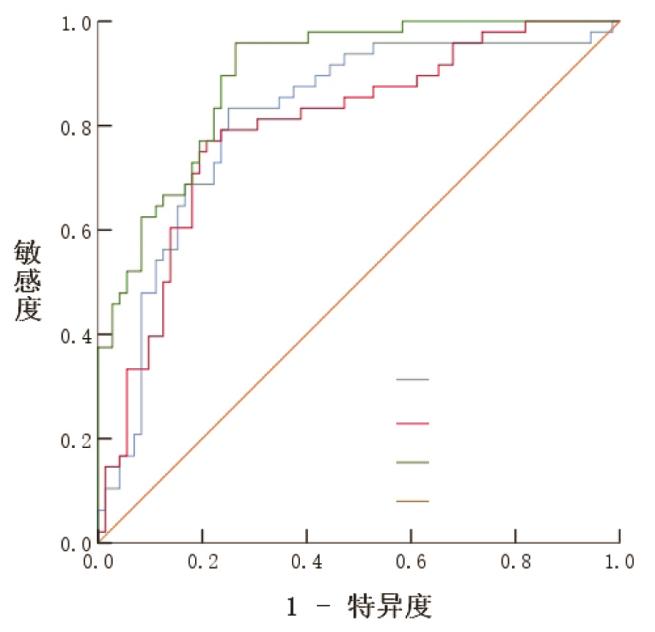
| 指标 | AUC | 95%CI | 截断值 | 敏感度 (%) | 特异度 (%) | 约登 指数 |
|---|---|---|---|---|---|---|
| IGF1(pg/mL) | 0.814 | 0.732~0.879 | 82.31 | 83.33 | 75.00 | 0.583 |
| SHBG(nmol/L) | 0.796 | 0.713~0.864 | 20.87 | 77.08 | 79.17 | 0.563 |
| 联合预测 | 0.896 | 0.827~0.944 | - | 95.83 | 73.61 | 0.694 |
| 指标 | AUC | 95%CI | 截断值 | 敏感度 (%) | 特异度 (%) | 约登 指数 |
|---|---|---|---|---|---|---|
| IGF1(pg/mL) | 0.814 | 0.732~0.879 | 82.31 | 83.33 | 75.00 | 0.583 |
| SHBG(nmol/L) | 0.796 | 0.713~0.864 | 20.87 | 77.08 | 79.17 | 0.563 |
| 联合预测 | 0.896 | 0.827~0.944 | - | 95.83 | 73.61 | 0.694 |
| [1] | 张永清, 陈丹青, 陈路萍, 等. 基于倾向性评分匹配探讨妊娠早期空腹血清ANGPTL-2及ANGPTL-8水平预测妊娠期糖尿病的价值[J]. 国际妇产科学杂志, 2024, 51(5):536-540. doi: 10.12280/gjfckx.20240680. |
| [2] | Champion ML, Battarbee AN, Biggio JR, et al. Postpartum glucose intolerance following early gestational diabetes mellitus[J]. Am J Obstet Gynecol MFM, 2022, 4(3):100609. doi: 10.1016/j.ajogmf.2022.100609. |
| [3] | Knudsen LL, Knorr S, Prange SK, et al. Clinical and Metabolic Characterization of Women With Gestational Diabetes Mellitus Within the First Year Postpartum[J]. J Endocr Soc, 2024, 8(6):bvae044. doi: 10.1210/jendso/bvae044. |
| [4] | 曾晨, 乔虹. 胰岛素样生长因子1、胰岛素生长因子结合蛋白在糖尿病合并结直肠癌中的研究进展[J]. 癌症进展, 2022, 20(9):888-890,893. doi: 10.11877/j.issn.1672-1535.2022.20.09.05. |
| [5] | Krishnan HR, Vallerini GP, Gavin HE, et al. Effects of alcohol and PARP inhibition on RNA ribosomal engagement in cortical excitatory neurons[J]. Front Mol Neurosci, 2023, 16:1125160. doi: 10.3389/fnmol.2023.1125160. |
| [6] | 李桂花, 廖丹, 王玲, 等. 妊娠期糖尿病患者血清PAPP-A、SHBG水平与膳食抗炎指数和产后血糖转归关系[J]. 中国计划生育学杂志, 2023, 31(8):1931-1934,1938. doi: 10.3969/j.issn.1004-8189.2023.08.034. |
| [7] | 中华医学会妇产科学分会产科学组, 中华医学会围产医学分会妊娠合并糖尿病协作组. 妊娠合并糖尿病诊治指南(2014)[J]. 中华妇产科杂志, 2014, 49(8):561-569. doi: 10.3760/cma.j.issn.0529-567x.2014.08.001. |
| [8] | American Diabetes Association. 14. Management of Diabetes in Pregnancy: Standards of Medical Care in Diabetes-2019[J]. Diabetes Care, 2019, 42(Suppl 1):S165-S172. doi: 10.2337/dc19-S014. |
| [9] | 中华医学会糖尿病学分会. 中国2型糖尿病防治指南(2020年版)[J]. 中华糖尿病杂志, 2021, 13(4):315-409. doi: 10.3760/cma.j.cn115791-20210221-00095. |
| [10] | Karavasileiadou S, Almegwely W, Alanazi A, et al. Self-management and self-efficacy of women with gestational diabetes mellitus: a systematic review[J]. Glob Health Action, 2022, 15(1):2087298. doi: 10.1080/16549716.2022.2087298. |
| [11] | 王红梅, 李锐, 张杰, 等. 不同胰岛素联合二甲双胍对妊娠期糖尿病血清VEGF、ADP、ANGPTL8表达水平的影响[J]. 中国妇产科临床杂志, 2025, 26(1):47-50. doi: 10.13390/j.issn.1672-1861.2025.01.014. |
| [12] | Lu W, Hu C. Molecular biomarkers for gestational diabetes mellitus and postpartum diabetes[J]. Chin Med J(Engl), 2022, 135(16):1940-1951. doi: 10.1097/CM9.0000000000002160. |
| [13] | Eng PC, Teo AE, Yew TW, et al. Implementing care for women with gestational diabetes after delivery-the challenges ahead[J]. Front Glob Womens Health, 2024, 5:1391213. doi: 10.3389/fgwh.2024.1391213. |
| [14] | 贺秀萍, 祝玉荣. 孕晚期妊娠期糖尿病患者血清血管粘附蛋白-1和五聚素3表达水平与产后血糖转归的相关性分析[J]. 中国妇幼保健, 2021, 36(18):4190-4194. doi: 10.19829/j.zgfybj.issn.1001-4411.2021.18.014. |
| [15] | Pardridge WM. Receptor-mediated drug delivery of bispecific therapeutic antibodies through the blood-brain barrier[J]. Front Drug Deliv, 2023, 3:1227816. doi: 10.3389/fddev.2023.1227816. |
| [16] | 黄风玲, 杨辰华, 朱翠翠, 等. 基于PI3K/Akt/NF-κB信号通路探讨加味升降散对糖尿病肾病小鼠肾损伤的干预机制[J]. 中医药学报, 2024, 52(1):20-26. doi: 10.19664/j.cnki.1002-2392.240005. |
| [17] | 黄蕾, 汪燕燕, 孙冉, 等. 人参皂苷Rg1通过抑制MAPK-NLRP1通路减轻2型糖尿病诱导的神经元损伤[J]. 中国药理学通报, 2023, 39(11):2034-2042. doi: 10.12360/CPB202306009. |
| [18] | Xie YP, Lin S, Xie BY, et al. Recent progress in metabolic reprogramming in gestational diabetes mellitus: a review[J]. Front Endocrinol(Lausanne), 2023, 14:1284160. doi: 10.3389/fendo.2023.1284160. |
| [19] |
Raeisi-Dehkordi H, Amiri M, Rathmann W, et al. Sex hormone-binding globulin may explain sex differences for glucose homeostasis and incidence of type 2 diabetes: the KORA study[J]. Eur J Epidemiol, 2024, 39(8):915-924. doi: 10.1007/s10654-024-01136-2.
pmid: 38954350 |
| [20] |
Kumar A, Vanamail P, Gupta RK, et al. Prediction of pre-eclampsia in diabetic pregnant women[J]. Indian J Med Res, 2023, 157(4):330-344. doi: 10.4103/ijmr.IJMR_1594_19.
pmid: 37282396 |
| [21] | Bizoń A, Franik G, Niepsuj J, et al. The Associations between Sex Hormones and Lipid Profiles in Serum of Women with Different Phenotypes of Polycystic Ovary Syndrome[J]. J Clin Med, 2021, 10(17):3941. doi: 10.3390/jcm10173941. |
| [22] | Antonio L, Pauwels S, Laurent MR, et al. Free Testosterone Reflects Metabolic as well as Ovarian Disturbances in Subfertile Oligomenorrheic Women[J]. Int J Endocrinol, 2018, 2018:7956951. doi: 10.1155/2018/7956951. |
| [23] | Wang K, Li Y, Chen Y. Androgen excess: a hallmark of polycystic ovary syndrome[J]. Front Endocrinol(Lausanne), 2023, 14:1273542. doi: 10.3389/fendo.2023.1273542. |
| [24] | Bhattacharya K, Dey R, Sen D, et al. Polycystic ovary syndrome and its management: In view of oxidative stress[J]. Biomol Concepts, 2024 Jan 19, 15(1). doi: 10.1515/bmc-2022-0038. |
| [1] | LIU Xiao-xiao, NIU Yu-qin, DING Kun, CHEN Ya-xue. The Effect of Inositol Supplementation on Blood Glucose and Incidence of Gestational Diabetes Mellitus in Pregnant Women: A Meta-Analysis [J]. Journal of International Obstetrics and Gynecology, 2026, 53(2): 170-176. |
| [2] | WANG Ping, LI Zhi-yue, LU Qin, JIA Yu-fang. Research Status of Efficacy Prediction Models for External Cephalic Version [J]. Journal of International Obstetrics and Gynecology, 2025, 52(6): 660-663. |
| [3] | FAN Bo-yang, HU Li-yan. Research Advancements on the Pathogenesis and Prediction Approaches of Twin Pregnancies Complicated with Preeclampsia [J]. Journal of International Obstetrics and Gynecology, 2024, 51(6): 611-615. |
| [4] | ZHANG Yong-qing, CHEN Dan-qing, CHEN Lu-ping, MA Xin-rui, CAI Wang-ying, WANG Mei-lin. The Value of Early Pregnancy Fasting Serum ANGPTL-2 and ANGPTL-8 Levels in Predicting Gestational Diabetes Mellitus Based on Propensity Score Matching [J]. Journal of International Obstetrics and Gynecology, 2024, 51(5): 536-540. |
| [5] | LIU Zhao, ZHAO Lin-lin, LI Xia, WANG Xi-xian. Study on the Interaction and Predictive Value of Early Pregnancy BMI and 25-(OH)D3 in Gestational Diabetes Mellitus [J]. Journal of International Obstetrics and Gynecology, 2024, 51(5): 541-545. |
| [6] | WU Zhi-wei, LIN Xue-yan, ZHANG Xue-qin, YANG Mei-lin. The Prevention and Prediction of Pre-Eclampsia: Recent Advances and the Way Forward [J]. Journal of International Obstetrics and Gynecology, 2024, 51(3): 312-316. |
| [7] | GAO Jing, QIN Fei, CHEN Chao, XIONG Yao-xi, CHENG Wei-wei. Analysis of Macrosomia Risk between Pregnancy Weight Gain and Glycolipid Metabolism among Normal Pregnant Women [J]. Journal of International Obstetrics and Gynecology, 2024, 51(2): 176-180. |
| [8] | ZHANG Ting, CHEN Zhen-yu, LIU Sen, ZHANG Xiao-hong, LI Ya-meng, LI Cai-xi. Construction and Validation of A Predictive Model for Adverse Pregnancy Outcomes in Preeclampsia [J]. Journal of International Obstetrics and Gynecology, 2024, 51(1): 21-27. |
| [9] | ZHAO Xue-qing, WANG Yong-qing. High Risk Factors and Pathogenesis of Cervical Incompetence [J]. Journal of International Obstetrics and Gynecology, 2024, 51(1): 87-92. |
| [10] | QIN Shi-yi, SHAO Yong. Research Progress on the Application of Shock Index in Postpartum Hemorrhage [J]. Journal of International Obstetrics and Gynecology, 2023, 50(5): 491-496. |
| [11] | ZHANG Yan-fei, WANG Yi-xuan, ZHANG Shao-hua, CHU Ying, WANG Zan-hong. Construction and Validation of the Nomogram Prediction Model for Postoperative Infection after Cesarean Section [J]. Journal of International Obstetrics and Gynecology, 2023, 50(4): 421-427. |
| [12] | LI Hui, ZHAO Xin, ZHANG Mei-hua. Establishment of A Nomogram Model to Predict the Risk of Macrosomia in Patients with Hyperglycemia in Pregnancy [J]. Journal of International Obstetrics and Gynecology, 2023, 50(1): 88-93. |
| [13] | YIN Ya-dong, LIU Lan. Research Progress of Endogenous Peptides in Gestational Diabetes Mellitus [J]. Journal of International Obstetrics and Gynecology, 2021, 48(6): 651-655. |
| [14] | JIANG Xiang, YING Hao. The Interpretation of 2021 ACOG Practice Bulletin: Prediction and Prevention of Spontaneous Preterm Birth [J]. Journal of International Obstetrics and Gynecology, 2021, 48(6): 684-690. |
| [15] | LOU Hai-feng, CHEN Dan-qing. Process of Adipokines in First Trimester for Predicting Gestational Diabetes Mellitus [J]. Journal of International Obstetrics and Gynecology, 2021, 48(5): 494-498. |
| Viewed | ||||||
|
Full text |
|
|||||
|
Abstract |
|
|||||
