Journal of International Obstetrics and Gynecology ›› 2025, Vol. 52 ›› Issue (6): 696-701.doi: 10.12280/gjfckx.20250696
• Research on Gynecological Malignancies: Review • Previous Articles Next Articles
SUN Ya-ge, ZHANG Yun-feng, LU Yue, GUO Jing-jing, XIANG Xiao-ying, JIA Han, WANG Yue( )
)
Received:2025-06-24
Published:2025-12-15
Online:2025-12-30
Contact:
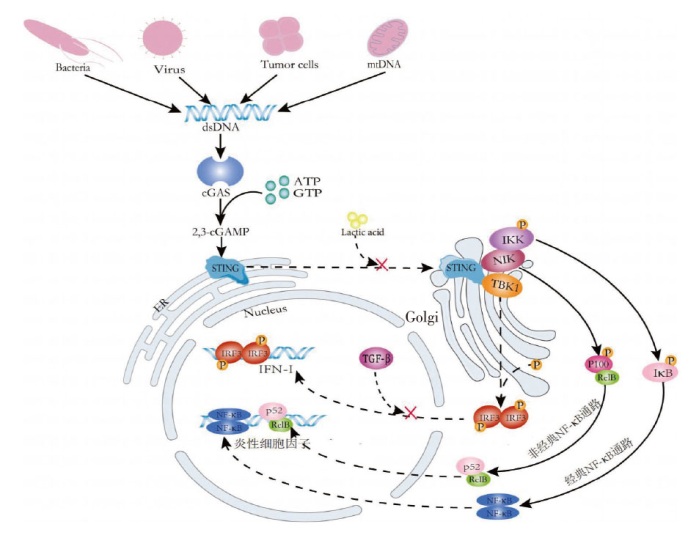
WANG Yue
E-mail:wangyue0601@163.com
SUN Ya-ge, ZHANG Yun-feng, LU Yue, GUO Jing-jing, XIANG Xiao-ying, JIA Han, WANG Yue. Research Progress on the cGAS-STING Signaling Pathway in Ovarian Cancer[J]. Journal of International Obstetrics and Gynecology, 2025, 52(6): 696-701.
Add to citation manager EndNote|Ris|BibTeX
| [1] | Bray F, Laversanne M, Sung H, et al. Global cancer statistics 2022: GLOBOCAN estimates of incidence and mortality worldwide for 36 cancers in 185 countries[J]. CA Cancer J Clin, 2024, 74(3):229-263. doi: 10.3322/caac.21834. |
| [2] | Liu J, Liu C, Ma Y, et al. STING inhibitors sensitize platinum chemotherapy in ovarian cancer by inhibiting the CGAS-STING pathway in cancer-associated fibroblasts (CAFs)[J]. Cancer Lett, 2024, 588:216700. doi: 10.1016/j.canlet.2024.216700. |
| [3] | Ma XY, Chen MM, Meng LH. Second messenger 2′3′-cyclic GMP-AMP (2′3′-cGAMP): the cell autonomous and non-autonomous roles in cancer progression[J]. Acta Pharmacol Sin, 2024, 45(5):890-899. doi: 10.1038/s41401-023-01210-7. |
| [4] | Li R, Liu H, Liu Y. The cGAS-STING pathway and female reproductive system diseases[J]. Front Immunol, 2024, 15:1447719. doi: 10.3389/fimmu.2024.1447719. |
| [5] | Zhang Z, Zhao H, Chu C, et al. The emerging roles of TLR and cGAS signaling in tumorigenesis and progression of ovarian cancer[J]. Front Pharmacol, 2022, 13:1072670. doi: 10.3389/fphar.2022.1072670. |
| [6] | Chen C, Xu P. Cellular functions of cGAS-STING signaling[J]. Trends Cell Biol, 2023, 33(8):630-648. doi: 10.1016/j.tcb.2022.11.001. |
| [7] | Li L, He Y, Chen Y, et al. cGAS-STING Pathway′s Impact on Intestinal Barrier[J]. J Gastroenterol Hepatol, 2025, 40(6):1381-1392. doi: 10.1111/jgh.16974. |
| [8] |
Abe T, Barber GN. Cytosolic-DNA-mediated, STING-dependent proinflammatory gene induction necessitates canonical NF-κB activation through TBK1[J]. J Virol, 2014, 88(10):5328-5341. doi: 10.1128/JVI.00037-14.
pmid: 24600004 |
| [9] |
Guerin MV, Regnier F, Feuillet V, et al. TGFβ blocks IFNα/β release and tumor rejection in spontaneous mammary tumors[J]. Nat Commun, 2019, 10(1):4131. doi: 10.1038/s41467-019-11998-w.
pmid: 31511510 |
| [10] |
Wang S, Qin L, Liu F, et al. Unveiling the crossroads of STING signaling pathway and metabolic reprogramming: the multifaceted role of the STING in the TME and new prospects in cancer therapies[J]. Cell Commun Signal, 2025, 23(1):171. doi: 10.1186/s12964-025-02169-0.
pmid: 40197235 |
| [11] | Li Q, Wu P, Du Q, et al. cGAS-STING, an important signaling pathway in diseases and their therapy[J]. MedComm(2020), 2024, 5(4):e511. doi: 10.1002/mco2.511. |
| [12] | Demeule M, Currie JC, Charfi C, et al. Sudocetaxel Zendusortide (TH1902) triggers the cGAS/STING pathway and potentiates anti-PD-L1 immune-mediated tumor cell killing[J]. Front Immunol, 2024, 15:1355945. doi: 10.3389/fimmu.2024.1355945. |
| [13] | Liu R, Hu R, Zeng Y, et al. Tumour immune cell infiltration and survival after platinum-based chemotherapy in high-grade serous ovarian cancer subtypes: A gene expression-based computational study[J]. EBioMedicine, 2020, 51:102602. doi: 10.1016/j.ebiom.2019.102602. |
| [14] |
Garland KM, Sheehy TL, Wilson JT. Chemical and Biomolecular Strategies for STING Pathway Activation in Cancer Immunotherapy[J]. Chem Rev, 2022, 122(6):5977-6039. doi: 10.1021/acs.chemrev.1c00750.
pmid: 35107989 |
| [15] | Du JM, Qian MJ, Yuan T, et al. cGAS and cancer therapy: a double-edged sword[J]. Acta Pharmacol Sin, 2022, 43(9):2202-2211. doi: 10.1038/s41401-021-00839-6. |
| [16] | Fujiwara Y, Kato S, Nesline MK, et al. Indoleamine 2,3-dioxygenase (IDO) inhibitors and cancer immunotherapy[J]. Cancer Treat Rev, 2022, 110:102461. doi: 10.1016/j.ctrv.2022.102461. |
| [17] |
An H, Zhao W, Hou J, et al. SHP-2 phosphatase negatively regulates the TRIF adaptor protein-dependent type I interferon and proinflammatory cytokine production[J]. Immunity, 2006, 25(6):919-928. doi: 10.1016/j.immuni.2006.10.014.
pmid: 17157040 |
| [18] | Zhang C, Shang G, Gui X, et al. Structural basis of STING binding with and phosphorylation by TBK1[J]. Nature, 2019, 567(7748):394-398. doi: 10.1038/s41586-019-1000-2. |
| [19] | Ying X, Chen Q, Yang Y, et al. Nanomedicines harnessing cGAS-STING pathway: sparking immune revitalization to transform ′cold′ tumors into ′hot′ tumors[J]. Mol Cancer, 2024, 23(1):277. doi: 10.1186/s12943-024-02186-6. |
| [20] |
Corrales L, Glickman LH, McWhirter SM, et al. Direct Activation of STING in the Tumor Microenvironment Leads to Potent and Systemic Tumor Regression and Immunity[J]. Cell Rep, 2015, 11(7):1018-1030. doi: 10.1016/j.celrep.2015.04.031.
pmid: 25959818 |
| [21] | Harrington K, Brody J, Ingham M, et al. LBA15 - Preliminary results of the first-in-human (FIH) study of MK-1454, an agonist of stimulator of interferon genes (STING), as monotherapy or in combination with pembrolizumab (pembro) in patients with advanced solid tumors or lymphomas[J]. Ann Oncol, 2018, 29(Suppl 8):viii 712. doi: 10.1093/annonc/mdy424.015 |
| [22] | Luke JJ, Piha-Paul SA, Medina T, et al. Phase I Study of SYNB1891, an Engineered E. coli Nissle Strain Expressing STING Agonist, with and without Atezolizumab in Advanced Malignancies[J]. Clin Cancer Res, 2023, 29(13):2435-2444. doi: 10.1158/1078-0432.CCR-23-0118. |
| [23] | Vasiyani H, Wadhwa B. STING activation and overcoming the challenges associated with STING agonists using ADC (antibody-drug conjugate) and other delivery systems[J]. Cell Signal, 2025, 128:111647. doi: 10.1016/j.cellsig.2025.111647. |
| [24] |
Chen X, Xu Z, Li T, et al. Nanomaterial-encapsulated STING agonists for immune modulation in cancer therapy[J]. Biomark Res, 2024, 12(1):2. doi: 10.1186/s40364-023-00551-z.
pmid: 38185685 |
| [25] | Ramanjulu JM, Pesiridis GS, Yang J, et al. Design of amidobenzimidazole STING receptor agonists with systemic activity[J]. Nature, 2018, 564(7736):439-443. doi: 10.1038/s41586-018-0705-y. |
| [26] |
Chin EN, Yu C, Vartabedian VF, et al. Antitumor activity of a systemic STING-activating non-nucleotide cGAMP mimetic[J]. Science, 2020, 369(6506):993-999. doi: 10.1126/science.abb4255.
pmid: 32820126 |
| [27] | Ding L, Wang Q, Martincuks A, et al. STING agonism overcomes STAT3-mediated immunosuppression and adaptive resistance to PARP inhibition in ovarian cancer[J]. J Immunother Cancer, 2023, 11(1):e005627. doi: 10.1136/jitc-2022-005627. |
| [28] | Lewicky JD, Martel AL, Gupta MR, et al. Conventional DNA-Damaging Cancer Therapies and Emerging cGAS-STING Activation: A Review and Perspectives Regarding Immunotherapeutic Potential[J]. Cancers(Basel), 2023, 15(16):4127. doi: 10.3390/cancers15164127. |
| [29] | Yu J, Zhang Q, Li J, et al. Sequential administration of pemetrexed and cisplatin reprograms tumor immune microenvironment and potentiates PD-1/PD-L1 treatment in a lung cancer model[J]. J Investig Med, 2022, 70(3):792-799. doi: 10.1136/jim-2021-002159. |
| [30] |
Grabosch S, Bulatovic M, Zeng F, et al. Cisplatin-induced immune modulation in ovarian cancer mouse models with distinct inflammation profiles[J]. Oncogene, 2019, 38(13):2380-2393. doi: 10.1038/s41388-018-0581-9.
pmid: 30518877 |
| [31] | Huang M, Cha Z, Liu R, et al. Enhancing immunotherapy outcomes by targeted remodeling of the tumor microenvironment via combined cGAS-STING pathway strategies[J]. Front Immunol, 2024, 15:1399926. doi: 10.3389/fimmu.2024.1399926. |
| [32] | Yi M, Niu M, Wu Y, et al. Combination of oral STING agonist MSA-2 and anti-TGF-β/PD-L1 bispecific antibody YM101: a novel immune cocktail therapy for non-inflamed tumors[J]. J Hematol Oncol, 2022, 15(1):142. doi: 10.1186/s13045-022-01363-8. |
| [33] |
Ding L, Kim HJ, Wang Q, et al. PARP Inhibition Elicits STING-Dependent Antitumor Immunity in Brca1-Deficient Ovarian Cancer[J]. Cell Rep, 2018, 25(11):2972-2980.e5. doi: 10.1016/j.celrep.2018.11.054.
pmid: 30540933 |
| [34] | Borella F, Carosso M, Chiparo MP, et al. Oncolytic Viruses in Ovarian Cancer: Where Do We Stand? A Narrative Review[J]. Pathogens, 2025, 14(2):140. doi: 10.3390/pathogens14020140. |
| [35] |
Hong B, Chapa V, Saini U, et al. Oncolytic HSV Therapy Modulates Vesicular Trafficking Inducing Cisplatin Sensitivity and Antitumor Immunity[J]. Clin Cancer Res, 2021, 27(2):542-553. doi: 10.1158/1078-0432.CCR-20-2210.
pmid: 33087329 |
| [1] | WU Hua-tuo, HUANG Chun-lin, MA Yan, GE Ting, LI Li. Research Progress on the Immune Microenvironment of Ovarian Cancer [J]. Journal of International Obstetrics and Gynecology, 2026, 53(3): 297-301. |
| [2] | XU Meng-ting, LU Di, SONG Dian-rong. Research Progress in the Tumor Microenvironment of Ovarian Cancer [J]. Journal of International Obstetrics and Gynecology, 2026, 53(2): 188-193. |
| [3] | WANG Ju-peng, REN Li, MA Ming-kun, ZHAO Ran, WEN Xue-hong. Expression Characteristics of KRT18 in Ovarian Cancer and Its Association with Patient Survival and Tumor Immune Microenvironment [J]. Journal of International Obstetrics and Gynecology, 2026, 53(2): 211-219. |
| [4] | ZHANG Meng-jie, JIAO Jin-wen, WANG Li-ming. A Case of Port Site Metastasis Secondary to Abdominal Paracentesis Drainage in Advanced Ovarian Cancer [J]. Journal of International Obstetrics and Gynecology, 2026, 53(2): 237-240. |
| [5] | XU Tian, PING Yi. Research Progress on Non-Coding RNAs Regulation of Ferroptosis in Ovarian Cancer [J]. Journal of International Obstetrics and Gynecology, 2026, 53(1): 12-17. |
| [6] | LI Na, LIU Hai-yan, TAN Li-li. Primary Ovarian Epithelioid Angiosarcoma:A Case Report [J]. Journal of International Obstetrics and Gynecology, 2026, 53(1): 22-26. |
| [7] | LI Xue-jian, WU Bo-qiong, WEN Jin-ying, PENG Jian-feng, CHEN Yu. Low-Grade Appendiceal Mucinous Neoplasm Misdiagnosed as Ovarian Tumor: A Case Report [J]. Journal of International Obstetrics and Gynecology, 2026, 53(1): 33-37. |
| [8] | XU Ruo-lan, YANG Jiang, WANG Ran-ran, ZHOU Jin-ting. Research Progress on Circulating Tumor DNA in the Early Diagnosis of Ovarian Cancer [J]. Journal of International Obstetrics and Gynecology, 2026, 53(1): 8-11. |
| [9] | GAO Yue, SHI Bai-chao, YU Jian-nan, ZHANG Li-qian, WANG Yu, WU Xiao-ke. Research Progress on the Anti-Gynecological Malignancy Effects of Chinese Herbal Polysaccharides [J]. Journal of International Obstetrics and Gynecology, 2025, 52(6): 685-689. |
| [10] | XIE Jiu-mei, WANG Yu, CHEN Xiang-nan, ZHANG Li-qian, WU Xiao-ke. Research Progress on the Intervention of Ovarian Cancer by Chinese Medicine Monomers and Compounds through Regulating the NF-κB Signaling Pathway [J]. Journal of International Obstetrics and Gynecology, 2025, 52(6): 690-695. |
| [11] | ZHOU Yuan, WANG Zhen-zhen, CAO Meng-dong, YU Han, SHEN Xue. Misdiagnosis of Pelvic Splenosis as Ovarian Tumor: A Case Report [J]. Journal of International Obstetrics and Gynecology, 2025, 52(6): 708-711. |
| [12] | ZHOU Ling-ling, SONG Jian-dong, Sarina . Research Progress of LncRNA HOTAIR in Gynecological Malignant Tumors [J]. Journal of International Obstetrics and Gynecology, 2025, 52(5): 481-485. |
| [13] | QIN Chen, ZHANG Wei, LI Li. Role of Lipid Metabolism Reprogramming in the Progression and Drug Resistance of Ovarian Cancer [J]. Journal of International Obstetrics and Gynecology, 2025, 52(5): 492-497. |
| [14] | LI Zu-wen, GUO Jie, SONG Dian-rong. Research Progress on the Immune Evasion Mechanism of Human Papilloma Virus [J]. Journal of International Obstetrics and Gynecology, 2025, 52(4): 420-424. |
| [15] | CHENG Xiao-ran, ZHAO Dan, NIU Cheng-zhi. Machine Learning Diagnostic Model for Ovarian Malignancies Based on Laboratory Data [J]. Journal of International Obstetrics and Gynecology, 2025, 52(4): 431-438. |
| Viewed | ||||||
|
Full text |
|
|||||
|
Abstract |
|
|||||