
Journal of International Obstetrics and Gynecology ›› 2026, Vol. 53 ›› Issue (1): 65-72.doi: 10.12280/gjfckx.20251078
• Gynecological Disease & Related Research: Review • Previous Articles Next Articles
YU Mao, LIN Zhong, ZHU Xue-hong, MO Si-en( )
)
Received:2025-09-22
Published:2026-02-15
Online:2026-03-11
Contact:
MO Si-en
E-mail:380231941@qq.com
YU Mao, LIN Zhong, ZHU Xue-hong, MO Si-en. Research Progress on Platelet-Rich Plasma Therapy in the Repair of Endometrial Injury[J]. Journal of International Obstetrics and Gynecology, 2026, 53(1): 65-72.
Add to citation manager EndNote|Ris|BibTeX
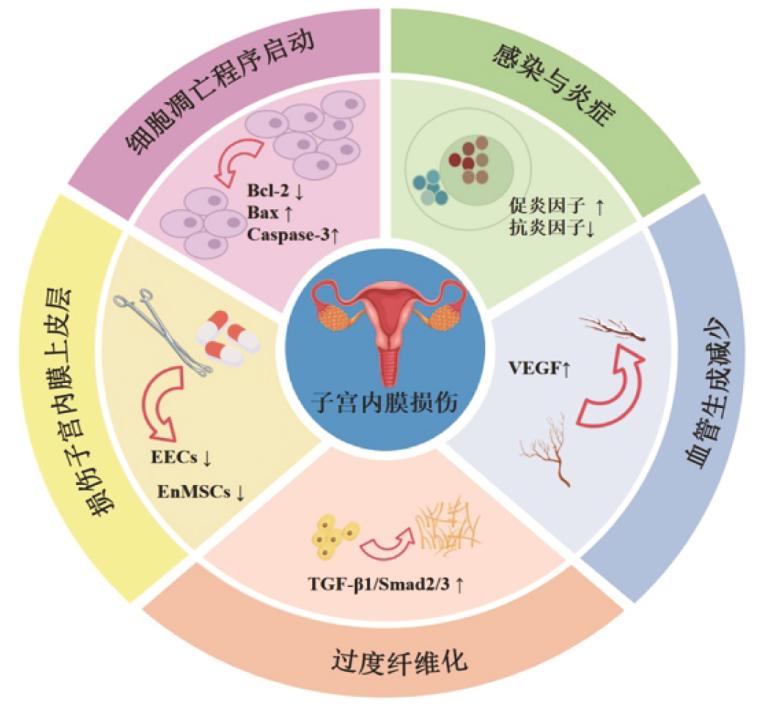
| 疾病 | 主要病因机制 | 主要病理特点 | 诊断标准 | 常用治疗方式 |
|---|---|---|---|---|
| TE[ | 器械/药物直接损伤 | EEC、EnMSC及腺体数量骤降;VEGF降低; 子宫动脉血流阻力增加 | 子宫内膜厚度<7 mm | 雌激素为主的激素类药物 |
| CE[ | 微生物感染 | 浆细胞在子宫内膜间质区持续浸润 | ≥1个浆细胞/高倍视野 | 广谱抗生素 |
| IUA[ | 内膜过度纤维化 | 成纤维细胞过度增殖;ECM过度沉积 | 宫腔镜评估粘连程度 | 宫腔镜下宫腔粘连分离术 |
| 疾病 | 主要病因机制 | 主要病理特点 | 诊断标准 | 常用治疗方式 |
|---|---|---|---|---|
| TE[ | 器械/药物直接损伤 | EEC、EnMSC及腺体数量骤降;VEGF降低; 子宫动脉血流阻力增加 | 子宫内膜厚度<7 mm | 雌激素为主的激素类药物 |
| CE[ | 微生物感染 | 浆细胞在子宫内膜间质区持续浸润 | ≥1个浆细胞/高倍视野 | 广谱抗生素 |
| IUA[ | 内膜过度纤维化 | 成纤维细胞过度增殖;ECM过度沉积 | 宫腔镜评估粘连程度 | 宫腔镜下宫腔粘连分离术 |
| [1] | Marín Fermín T, Calcei JG, Della Vedova F, et al. Review of Dohan Eherenfest et al. (2009) on "Classification of platelet concentrates: From pure platelet-rich plasma (P-PRP) to leucocyte- and platelet-rich fibrin (L-PRF)"[J]. J ISAKOS,2024, 9(2):215-220. doi: 10.1016/j.jisako.2023.07.010. |
| [2] | 中国输血协会临床输血管理学专业委员会, 单桂秋, 施琳颖, 等. 自体富血小板血浆制备技术专家共识[J]. 中国输血杂志, 2021, 34(7):677-683. doi: 10.13303/j.cjbt.issn.1004-549x.2021.07.001. |
| [3] | 中国输血协会临床输血管理学专业委员会富血小板血浆创新技术专家联盟子宫修复项目组, 穆士杰, 赵树铭, 等. 自体单采富血小板血浆治疗薄型子宫内膜的专家共识[J]. 临床输血与检验, 2023, 25(3):289-296. doi: 10.3969/j.issn.1671-2587.2023.03.001. |
| [4] |
Mazumdar P, Biswas SS. Ramipril ameliorates endometriosis by inducing oxidative stress-mediated apoptosis in the wistar rat[J]. J Mol Histol, 2025, 56(2):117. doi: 10.1007/s10735-025-10397-4.
pmid: 40126675 |
| [5] | Zhao Q, Li Y, Zhao X, et al. Apelin-13 alleviates intrauterine adhesion by inhibiting epithelial-mesenchymal transition of endometrial epithelial cells and promoting angiogenesis[J]. Hum Cell, 2024, 37(6):1613-1623. doi: 10.1007/s13577-024-01117-3. |
| [6] | Liu X, Qian C, Jiang X, et al. Efficacy of platelet-rich plasma in the treatment of thin endometrium: a meta-analysis of randomized controlled trials[J]. BMC Pregnancy Childbirth, 2024, 24(1):567. doi: 10.1186/s12884-024-06741-3. |
| [7] | Yan X, Jiao J, Wang X. The pathogenesis, diagnosis, and treatment of chronic endometritis: a comprehensive review[J]. Front Endocrinol(Lausanne), 2025, 16:1603570. doi: 10.3389/fendo.2025.1603570. |
| [8] | 蒋建发, 徐大宝, 杨益民. 子宫内膜结核所致宫腔粘连的宫腔镜手术治疗及生育结局(英文)[J]. 中南大学学报(医学版), 2025, 50(1):52-60. doi: 10.11817/j.issn.1672-7347.2025.240022. |
| [9] |
Tersoglio AE, Tersoglio S, Salatino DR, et al. Regenerative therapy by endometrial mesenchymal stem cells in thin endometrium with repeated implantation failure. A novel strategy[J]. JBRA Assist Reprod, 2020, 24(2):118-127. doi: 10.5935/1518-0557.20190061.
pmid: 31589391 |
| [10] | Wang X, Liu L, Mou S, et al. Investigation of platelet-rich plasma in increasing proliferation and migration of endometrial mesenchymal stem cells and improving pregnancy outcome of patients with thin endometrium[J]. J Cell Biochem, 2019, 120(5):7403-7411. doi: 10.1002/jcb.28014. |
| [11] |
Zhang X, Zhang S, Qi J, et al. PDGFBB improved the biological function of menstrual blood-derived stromal cells and the anti-fibrotic properties of exosomes[J]. Stem Cell Res Ther, 2023, 14(1):113. doi: 10.1186/s13287-023-03339-y.
pmid: 37118830 |
| [12] | Zhan J, Jücker M. The Role of PI3K/AKT/mTOR Signaling in Tumor Radioresistance and Advances in Inhibitor Research[J]. Int J Mol Sci, 2025, 26(14):6853. doi: 10.3390/ijms26146853. |
| [13] |
Efendieva Z, Vishnyakova P, Apolikhina I, et al. Hysteroscopic injections of autologous endometrial cells and platelet-rich plasma in patients with thin endometrium: a pilot randomized study[J]. Sci Rep, 2023, 13(1):945. doi: 10.1038/s41598-023-27982-w.
pmid: 36653431 |
| [14] | Zhang Q, Qin D, Liu C, et al. Injectable Hydrogel Loaded with Plasma-Rich Platelets Repairing Endometrial Injury and Remodeling Reproductive Function by Regulating PI3K/AKT Pathway[J]. Small, 2025, 21(20):e2412177. doi: 10.1002/smll.202412177. |
| [15] |
Tanzadehpanah H, Nobari S, Hoseini AJ, et al. Effect of platelet-rich plasma on angiogenic and regenerative properties in patients with critical limb ischemia[J]. Regen Ther, 2025, 28:517-526. doi: 10.1016/j.reth.2025.01.008.
pmid: 39995496 |
| [16] | Lee Y, Fang Y, Kuila S, et al. Cross-family interactions of vascular endothelial growth factors and platelet-derived growth factors on the endothelial cell surface: A computational model[J]. bioRxiv,2025 Mar 4: 2025.02.27.640640. doi: 10.1101/2025.02.27.640640. |
| [17] | Lopez KE, Meola DM, Camarda ND, et al. Effect of the Vascular Endothelial Growth Factor Inhibitor Toceranib on Cardiac Function and Endothelial Dysfunction Biomarkers in Dogs With Cancer[J]. J Vet Intern Med, 2025, 39(3):e70115. doi: 10.1111/jvim.70115. |
| [18] | Kim SY, Kim JM, Chung KS, et al. In vitro and in vivo anti-inflammatory effects of 5-hydroxyconiferaldehyde via NF-κB, MAPK/AP-1, and Nrf2 modulation[J]. Chem Biol Interact, 2025, 409:111427. doi: 10.1016/j.cbi.2025.111427. |
| [19] | Chen X, Chen M, Liu M, et al. Intrauterine infusion of autologous platelet-rich plasma modulates endometrial immune status and improves pregnancy outcomes in patients with persistent chronic endometritis[J]. Front Immunol, 2025, 16:1528522. doi: 10.3389/fimmu.2025.1528522. |
| [20] | Liu X, Wang Y, Wen X, et al. Platelet rich plasma alleviates endometritis induced by lipopolysaccharide in mice via inhibiting TLR4/NF-κB signaling pathway[J]. Am J Reprod Immunol, 2024, 91(3):e13833. doi: 10.1111/aji.13833. |
| [21] |
Segabinazzi LG, Friso AM, Correal SB, et al. Uterine clinical findings, fertility rate, leucocyte migration, and COX-2 protein levels in the endometrial tissue of susceptible mares treated with platelet-rich plasma before and after AI[J]. Theriogenology, 2017, 104:120-126. doi: 10.1016/j.theriogenology.2017.08.007.
pmid: 28822903 |
| [22] | Yan S, Ding J, Wang Z, et al. CTRP6 alleviates endometrial fibrosis by regulating Smad3 pathway in intrauterine adhesion[J]. Biol Reprod, 2024, 111(2):322-331. doi: 10.1093/biolre/ioae016. |
| [23] | Qi J, Li X, Cao Y, et al. Locationally activated PRP via an injectable dual-network hydrogel for endometrial regeneration[J]. Biomaterials, 2024, 309:122615. doi: 10.1016/j.biomaterials.2024.122615. |
| [24] | Yang H, Zhang W, Fang J, et al. Intrauterine infusion of platelet-rich plasma improves fibrosis by transforming growth factor beta 1/Smad pathway in a rat intrauterine adhesion model[J]. Reprod Biol, 2024, 24(2):100882. doi: 10.1016/j.repbio.2024.100882. |
| [25] | Aghajanova L, Houshdaran S, Balayan S, et al. In vitro evidence that platelet-rich plasma stimulates cellular processes involved in endometrial regeneration[J]. J Assist Reprod Genet, 2018, 35(5):757-770. doi: 10.1007/s10815-018-1130-8. |
| [26] | Shin SY, Chung N, Shin JE, et al. Angiogenic factor-driven improvement of refractory thin endometrium with autologous platelet-rich plasma intrauterine infusion in frozen embryo transfer cycles[J]. Front Endocrinol(Lausanne), 2024, 15:1431453. doi: 10.3389/fendo.2024.1431453. |
| [27] | Alaee S, Zal F, Razban V, et al. PRP Influences Maturation and Fertilisation of Immature Mouse Oocytes[J]. Anat Histol Embryol, 2024, 53(6):e13112. doi: 10.1111/ahe.13112. |
| [28] | Lv Y, Zhou Y, Jin Z, et al. Structural characterization of galactomannan sulfated modification products with different molecular weight fractions and their in vitro anti-lung cancer activities[J]. Int J Biol Macromol, 2025, 315(Pt 1):144326. doi: 10.1016/j.ijbiomac.2025.144326. |
| [29] | Artimani T, Asl SS, Amiri I, et al. Effect of Different Concentrations of PRP on the Expression of Factors Involved in the Endometrial Receptivity in the Human Endometrial Cells from RIF Patients Compared to the Controls[J]. Reprod Sci, 2024, 31(12):3870-3879. doi: 10.1007/s43032-024-01744-z. |
| [30] |
Chang Y, Li J, Chen Y, et al. Autologous platelet-rich plasma promotes endometrial growth and improves pregnancy outcome during in vitro fertilization[J]. Int J Clin Exp Med, 2015, 8(1):1286-1290.
pmid: 25785127 |
| [31] | Agarwal M, Mettler L, Jain S, et al. Management of a Thin Endometrium by Hysteroscopic Instillation of Platelet-Rich Plasma Into The Endomyometrial Junction: A Pilot Study[J]. J Clin Med, 2020, 9(9):2795. doi: 10.3390/jcm9092795. |
| [32] | Yu TN, Lee TH, Lee MS, et al. Intrauterine Infusion and Hysteroscopic Injection of Autologous Platelet-Rich Plasma for Patients with a Persistent Thin Endometrium: A Prospective Case-Control Study[J]. J Clin Med, 2024, 13(10):2838. doi: 10.3390/jcm13102838. |
| [33] | Yuan G, Yu C, Du X, et al. Injectable GelMA Hydrogel Microspheres with Sustained Release of Platelet-Rich Plasma for the Treatment of Thin Endometrium[J]. Small, 2024, 20(47):e2403890. doi: 10.1002/smll.202403890. |
| [34] |
Sfakianoudis K, Simopoulou M, Nitsos N, et al. Successful Implantation and Live Birth Following Autologous Platelet-rich Plasma Treatment for a Patient with Recurrent Implantation Failure and Chronic Endometritis[J]. In Vivo, 2019, 33(2):515-521. doi: 10.21873/invivo.11504.
pmid: 30804135 |
| [35] | 周虹雨. 富血小板血浆宫腔灌注对反复种植失败合并慢性子宫内膜炎患者FET妊娠结局的影响[D]. 海口: 海南医学院, 2023. |
| [36] | Tang R, Xiao X, He Y, et al. Clinical evaluation of autologous platelet-rich plasma therapy for intrauterine adhesions: a systematic review and meta-analysis[J]. Front Endocrinol(Lausanne), 2023, 14:1183209. doi: 10.3389/fendo.2023.1183209. |
| [37] |
Ning J, Song M, Hu L, et al. Effects of platelet-rich plasma infusion therapy on surgical outcomes and fertility in patients with moderate to severe intrauterine adhesion[J]. Asian J Surg, 2024, 47(8):3798-3799. doi: 10.1016/j.asjsur.2024.04.134.
pmid: 38724375 |
| [38] | Wang G, Zhu Y, Duan N, et al. Does Platelet-Rich Plasma Improve Adhesion Recurrence and Pregnancy Outcomes in Women With Intrauterine Adhesions? A Systematic Review and Meta-Analysis[J]. J Minim Invasive Gynecol, 2025, 32(2):133-142.e7. doi: 10.1016/j.jmig.2024.10.013. |
| [39] | Fan HL, Wu XX, Wei HC, et al. Clinical efficacy of intrauterine platelet-rich plasma infusion in endometrial regeneration after hysteroscopic adhesiolysis: A retrospective cohort study[J]. Medicine(Baltimore), 2025, 104(32):e43754. doi: 10.1097/MD.0000000000043754. |
| [1] | YANG Yan, YAN Kai, ZHOU Deng-lian, DENG Xin. Exosomes in Endometrial Fibrosis: Mechanisms and Potential Diagnostic and Therapeutic Applications [J]. Journal of International Obstetrics and Gynecology, 2026, 53(3): 335-340. |
| [2] | LIU Hui-shan, CHEN Xing, DAI Hui-hua. Research Progress on Autophagy in Endometrial Diseases [J]. Journal of International Obstetrics and Gynecology, 2025, 52(6): 618-623. |
| [3] | ZHAO Rui-kun, ZHOU Qin. Research Progress on the Pathogenesis of Endometrial Polyps [J]. Journal of International Obstetrics and Gynecology, 2025, 52(6): 624-628. |
| [4] | ZENG Hui-fang, DOU Zhen, LI Yu-xin, JIANG Xin-yu, XIA Tian. Research Progress on Glucose and Lipid Metabolism in Decidualization of Endometrial Stromal Cells in Patients with PCOS [J]. Journal of International Obstetrics and Gynecology, 2025, 52(5): 534-539. |
| [5] | SU Han, GUO Jie, SONG Dian-rong, ZHANG Wei. Research Progress on the Mechanism of the Effect of Chronic Endometritis on Endometrial Receptivity [J]. Journal of International Obstetrics and Gynecology, 2025, 52(4): 451-456. |
| [6] | ZHAO Ming, ZHAN Hong, WU Rui-jin. Research Advances in Platelet Rich Plasma Therapy for Premature Ovarian Insufficiency [J]. Journal of International Obstetrics and Gynecology, 2025, 52(4): 462-466. |
| [7] | SHAO Meng-yu, MA Sai-hua, GONG Zheng, ZHAO Xiao-li, ZHAO Zhi-mei. Pathogenesis of Endometriosis Complicated with Chronic Endometritis and Its Impact on Reproduction [J]. Journal of International Obstetrics and Gynecology, 2025, 52(3): 241-245. |
| [8] | ZHANG Yong-qing, CHEN Zheng-yun, CHEN Lu-ping, YAN Guo-hui, CHEN Dan-qing. Two Cases of Term Angular Pregnancy Identified during Cesarean Section [J]. Journal of International Obstetrics and Gynecology, 2025, 52(2): 153-157. |
| [9] | LI Heng-bing, YUAN Hai-ning, ZHANG Yun-jie, ZHANG Jiang-lin, GUO Zi-zhen, SUN Zhen-gao. Advances in Exosome-Based Therapy for Chronic Endometritis by Modulating the Immune Microenvironment [J]. Journal of International Obstetrics and Gynecology, 2025, 52(1): 72-78. |
| [10] | ZHONG Xiao-ying, LIU Hai-yuan. Composition and Research Progress of the Endometrial Microbiota [J]. Journal of International Obstetrics and Gynecology, 2024, 51(5): 481-485. |
| [11] | LI Ying-tao, HUANG Xiao-wu. Evolution and Advances in Endometrial Sampling [J]. Journal of International Obstetrics and Gynecology, 2024, 51(1): 105-109. |
| [12] | LIU Hui-xing, BIN Li, ZHU Xue-hong, LIN Zhong, LU Li-miao. Research Progress of Estrogen Adjuvant Therapy after Transcervical Resection of Adhesions [J]. Journal of International Obstetrics and Gynecology, 2023, 50(6): 618-622. |
| [13] | REN Shu-qing, SONG Dian-rong, ZHANG Ji-wen, HUAI Qi-juan, ZHAO Lin, ZHANG Wei. Study on the Characteristics of Intrauterine Microbiota in Infertile Women with Poor Endometrial Receptivity [J]. Journal of International Obstetrics and Gynecology, 2023, 50(6): 704-710. |
| [14] | ZHANG Xiao-lei, DENG Dan-ni, GAO Yan, ZHANG Hui-min. Application of Organoids in Research of Endometrium and Endometrium-Related Diseases [J]. Journal of International Obstetrics and Gynecology, 2023, 50(4): 446-449. |
| [15] | WANG Song, ZHANG Wei, SONG Dian-rong. Research Progress of Female Genital Tract Inflammation in the Pathogenesis of Endometriosis [J]. Journal of International Obstetrics and Gynecology, 2023, 50(3): 251-255. |
| Viewed | ||||||
|
Full text |
|
|||||
|
Abstract |
|
|||||
