
Journal of International Obstetrics and Gynecology ›› 2026, Vol. 53 ›› Issue (2): 170-176.doi: 10.12280/gjfckx.20250615
• Obstetric Physiology & Obstetric Disease: Original Article • Previous Articles Next Articles
LIU Xiao-xiao, NIU Yu-qin, DING Kun, CHEN Ya-xue( )
)
Received:2025-06-04
Published:2026-04-15
Online:2026-05-08
Contact:
CHEN Ya-xue
E-mail:1214117960@qq.com
LIU Xiao-xiao, NIU Yu-qin, DING Kun, CHEN Ya-xue. The Effect of Inositol Supplementation on Blood Glucose and Incidence of Gestational Diabetes Mellitus in Pregnant Women: A Meta-Analysis[J]. Journal of International Obstetrics and Gynecology, 2026, 53(2): 170-176.
Add to citation manager EndNote|Ris|BibTeX
| 纳入研究 | 国家 | 样本量 (干预组/对照组) | 分组 | 年龄 (岁) | 妊娠前BMI (kg/m2) | 干预时间 | 结局指标 | 质量评分 (分) |
|---|---|---|---|---|---|---|---|---|
| 杨标顺[ | 中国 | 62/63 | 干预组:叶酸片200 μg+肌肉肌醇片2 g | 干预组:30.41±4.35 | 干预组:32.84±2.58 | 妊娠早期至分娩 | ①②③④⑤⑥ | 4 |
| 对照组:叶酸片200 μg | 对照组:29.54±3.97 | 对照组:33.14±2.11 | ||||||
| Farren等[ | 爱尔兰 | 117/117 | 干预组:叶酸片400 μg+肌肉肌醇片1 100 mg+DCI 27.6 mg | 干预组:31.1±5.1 | 干预组:26.0±5.3 | 妊娠早期至分娩 | ①④⑤⑥⑦⑧⑨⑩ | 5 |
| 对照组:叶酸片400 μg | 对照组:31.5±5.0 | 对照组:26.2±5.5 | ||||||
| Godfrey等[ | 英国、新加坡、新西兰 | 295/290 | 干预组:叶酸片400 μg+肌肉肌醇片4 g | 干预组:30.53±3.4 | 干预组: 23.65(21.16~26.23) | 妊娠前至妊娠结束 | ①④⑤⑥⑧⑨⑩ | 6 |
| 对照组:叶酸片400 μg | 对照组:30.14±3.3 | 对照组: 23.75(21.34~27.50) | ||||||
| Esmaeilzadeh等[ | 伊朗 | 27/29 | 干预组:叶酸片200 μg+肌肉肌醇片2 g | 干预组:27.8±4.2 | 干预组:27.3±1.8 | 妊娠14~24周至分娩 | ①②③④⑦⑧⑨? | 7 |
| 对照组:叶酸片400 μg | 对照组:29.3±4.4 | 对照组:26.9±1.9 | ||||||
| Amaefule等[ | 英国 | 99/99 | 干预组:叶酸片200 μg+肌肉肌醇片2 g | 干预组:31.4±5.8 | 干预组:28.2±6.4 | 妊娠早期至分娩 | ①②③④⑥⑧⑨ | 4 |
| 对照组:无 | 对照组:31.9±5.6 | 对照组:27.9±5.6 | ||||||
| Vitale等[ | 意大利 | 110/113 | 干预组:叶酸片200 μg+肌肉肌醇片2 g | 干预组:27.18±6.03 | 干预组:27.00±1.49 | 妊娠早期至分娩后3周 | ①④⑤⑥ | 6 |
| 对照组:叶酸片200 μg | 对照组:27.95±4.90 | 对照组:26.68±1.56 | ||||||
| Celetano等[ | 意大利 | 60/40 | 干预组:叶酸片400 μg+肌醇片4 g | 干预组:33.8±4.3 | 干预组:23.8±4.3 | 妊娠早期至分娩 | ①④⑤⑥⑧⑨⑩? | 4 |
| 对照组:叶酸片400 μg | 对照组:33.9±4.9 | 对照组:24.4±4.1 | ||||||
| Santamaria等[ | 意大利 | 95/102 | 干预组:叶酸片200 μg+肌肉肌醇片2 g | 干预组:32.1±4.8 | 干预组:26.9±1.3 | 妊娠早期至分娩 | ①④⑤⑥⑦⑧⑨⑩? | 5 |
| 对照组:叶酸片200 μg | 对照组:32.7±5.3 | 对照组:27.1±1.3 | ||||||
| D'Anna等[ | 意大利 | 110/110 | 干预组:叶酸片200 μg+肌肉肌醇片2 g | 干预组:30.9(18~44) | 干预组:33.8(30.0~46.9) | 妊娠早期至分娩 | ①②③④⑤⑥⑦⑧⑨⑩? | 5 |
| 对照组:叶酸片200 μg | 对照组:31.7(19~43) | 对照组:33.8(30.0~46.0) | ||||||
| Matarrelli等[ | 意大利 | 35/38 | 干预组:叶酸片400 μg+ 肌肉肌醇片4 g | 干预组:33.0±4.9 | 干预组:23.5±3.4 | 妊娠早期至分娩 | ①④⑤⑥⑩? | 7 |
| 对照组:叶酸片400 μg | 对照组:33.8±4.7 | 对照组:24.7±4.2 |
| 纳入研究 | 国家 | 样本量 (干预组/对照组) | 分组 | 年龄 (岁) | 妊娠前BMI (kg/m2) | 干预时间 | 结局指标 | 质量评分 (分) |
|---|---|---|---|---|---|---|---|---|
| 杨标顺[ | 中国 | 62/63 | 干预组:叶酸片200 μg+肌肉肌醇片2 g | 干预组:30.41±4.35 | 干预组:32.84±2.58 | 妊娠早期至分娩 | ①②③④⑤⑥ | 4 |
| 对照组:叶酸片200 μg | 对照组:29.54±3.97 | 对照组:33.14±2.11 | ||||||
| Farren等[ | 爱尔兰 | 117/117 | 干预组:叶酸片400 μg+肌肉肌醇片1 100 mg+DCI 27.6 mg | 干预组:31.1±5.1 | 干预组:26.0±5.3 | 妊娠早期至分娩 | ①④⑤⑥⑦⑧⑨⑩ | 5 |
| 对照组:叶酸片400 μg | 对照组:31.5±5.0 | 对照组:26.2±5.5 | ||||||
| Godfrey等[ | 英国、新加坡、新西兰 | 295/290 | 干预组:叶酸片400 μg+肌肉肌醇片4 g | 干预组:30.53±3.4 | 干预组: 23.65(21.16~26.23) | 妊娠前至妊娠结束 | ①④⑤⑥⑧⑨⑩ | 6 |
| 对照组:叶酸片400 μg | 对照组:30.14±3.3 | 对照组: 23.75(21.34~27.50) | ||||||
| Esmaeilzadeh等[ | 伊朗 | 27/29 | 干预组:叶酸片200 μg+肌肉肌醇片2 g | 干预组:27.8±4.2 | 干预组:27.3±1.8 | 妊娠14~24周至分娩 | ①②③④⑦⑧⑨? | 7 |
| 对照组:叶酸片400 μg | 对照组:29.3±4.4 | 对照组:26.9±1.9 | ||||||
| Amaefule等[ | 英国 | 99/99 | 干预组:叶酸片200 μg+肌肉肌醇片2 g | 干预组:31.4±5.8 | 干预组:28.2±6.4 | 妊娠早期至分娩 | ①②③④⑥⑧⑨ | 4 |
| 对照组:无 | 对照组:31.9±5.6 | 对照组:27.9±5.6 | ||||||
| Vitale等[ | 意大利 | 110/113 | 干预组:叶酸片200 μg+肌肉肌醇片2 g | 干预组:27.18±6.03 | 干预组:27.00±1.49 | 妊娠早期至分娩后3周 | ①④⑤⑥ | 6 |
| 对照组:叶酸片200 μg | 对照组:27.95±4.90 | 对照组:26.68±1.56 | ||||||
| Celetano等[ | 意大利 | 60/40 | 干预组:叶酸片400 μg+肌醇片4 g | 干预组:33.8±4.3 | 干预组:23.8±4.3 | 妊娠早期至分娩 | ①④⑤⑥⑧⑨⑩? | 4 |
| 对照组:叶酸片400 μg | 对照组:33.9±4.9 | 对照组:24.4±4.1 | ||||||
| Santamaria等[ | 意大利 | 95/102 | 干预组:叶酸片200 μg+肌肉肌醇片2 g | 干预组:32.1±4.8 | 干预组:26.9±1.3 | 妊娠早期至分娩 | ①④⑤⑥⑦⑧⑨⑩? | 5 |
| 对照组:叶酸片200 μg | 对照组:32.7±5.3 | 对照组:27.1±1.3 | ||||||
| D'Anna等[ | 意大利 | 110/110 | 干预组:叶酸片200 μg+肌肉肌醇片2 g | 干预组:30.9(18~44) | 干预组:33.8(30.0~46.9) | 妊娠早期至分娩 | ①②③④⑤⑥⑦⑧⑨⑩? | 5 |
| 对照组:叶酸片200 μg | 对照组:31.7(19~43) | 对照组:33.8(30.0~46.0) | ||||||
| Matarrelli等[ | 意大利 | 35/38 | 干预组:叶酸片400 μg+ 肌肉肌醇片4 g | 干预组:33.0±4.9 | 干预组:23.5±3.4 | 妊娠早期至分娩 | ①④⑤⑥⑩? | 7 |
| 对照组:叶酸片400 μg | 对照组:33.8±4.7 | 对照组:24.7±4.2 |
| 结局指标 | 纳入研究数量(篇) | 异质性检验 | 效应模型 | Meta分析结果 | ||
|---|---|---|---|---|---|---|
| I2(%) | P | MD(95%CI)或OR(95%CI) | P | |||
| 空腹血糖 | 10[ | 57 | 0.010 | 随机 | -2.97(-4.24~-1.70) | <0.001 |
| OGTT 1 h血糖 | 8[ | 80 | <0.001 | 随机 | -6.81(-13.41~-0.22) | 0.040 |
| OGTT 2 h血糖 | 9[ | 81 | <0.001 | 随机 | -6.31(-12.11~-0.52) | 0.030 |
| 空腹血清胰岛素 | 4[ | 10 | 0.340 | 固定 | -1.96(-3.29~-0.63) | 0.004 |
| 妊娠中晚期HOMA-IR | 4[ | 3 | 0.380 | 固定 | -0.44(-0.74~-0.14) | 0.005 |
| 妊娠期高血压疾病发生率 | 7[ | 0 | 0.530 | 固定 | 0.43(0.25~0.74) | 0.002 |
| 巨大儿发生率 | 4[ | 2 | 0.380 | 固定 | 1.09(0.59~2.03) | 0.790 |
| 早产儿发生率 | 7[ | 0 | 0.850 | 固定 | 0.47(0.30~0.72) | <0.001 |
| 新生儿低血糖发生率 | 6[ | 65 | 0.010 | 随机 | 0.45(0.10~2.03) | 0.300 |
| 胰岛素使用率 | 5[ | 0 | 0.640 | 固定 | 0.24(0.11~0.56) | <0.001 |
| 结局指标 | 纳入研究数量(篇) | 异质性检验 | 效应模型 | Meta分析结果 | ||
|---|---|---|---|---|---|---|
| I2(%) | P | MD(95%CI)或OR(95%CI) | P | |||
| 空腹血糖 | 10[ | 57 | 0.010 | 随机 | -2.97(-4.24~-1.70) | <0.001 |
| OGTT 1 h血糖 | 8[ | 80 | <0.001 | 随机 | -6.81(-13.41~-0.22) | 0.040 |
| OGTT 2 h血糖 | 9[ | 81 | <0.001 | 随机 | -6.31(-12.11~-0.52) | 0.030 |
| 空腹血清胰岛素 | 4[ | 10 | 0.340 | 固定 | -1.96(-3.29~-0.63) | 0.004 |
| 妊娠中晚期HOMA-IR | 4[ | 3 | 0.380 | 固定 | -0.44(-0.74~-0.14) | 0.005 |
| 妊娠期高血压疾病发生率 | 7[ | 0 | 0.530 | 固定 | 0.43(0.25~0.74) | 0.002 |
| 巨大儿发生率 | 4[ | 2 | 0.380 | 固定 | 1.09(0.59~2.03) | 0.790 |
| 早产儿发生率 | 7[ | 0 | 0.850 | 固定 | 0.47(0.30~0.72) | <0.001 |
| 新生儿低血糖发生率 | 6[ | 65 | 0.010 | 随机 | 0.45(0.10~2.03) | 0.300 |
| 胰岛素使用率 | 5[ | 0 | 0.640 | 固定 | 0.24(0.11~0.56) | <0.001 |
| 结局指标 | 固定效应模型 | 随机效应模型 | ||
|---|---|---|---|---|
| MD/OR | 95%CI | MD/OR | 95%CI | |
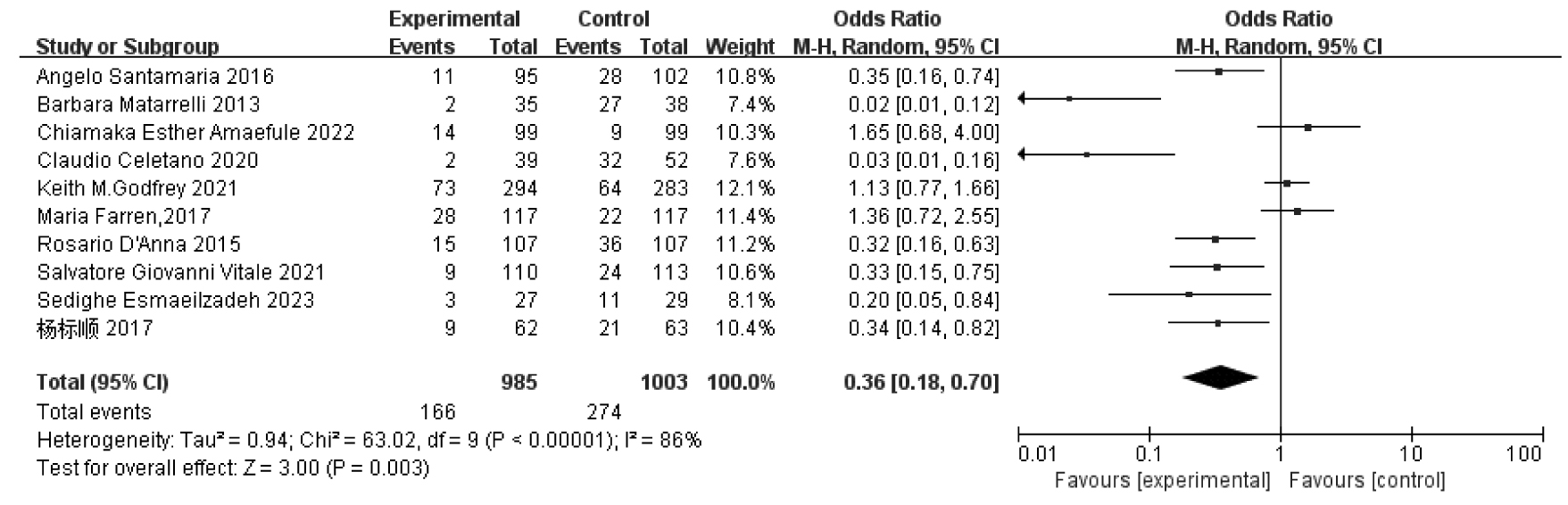
| GDM发生率 | 0.55 | 0.45~0.68 | 0.36 | 0.18~0.70 |
| 空腹血糖 | -2.43 | -3.07~-1.80 | -2.97 | -4.24~-1.70 |
| OGTT 1 h血糖 | -1.97 | -4.48~0.55 | -6.81 | -13.41~-0.22 |
| OGTT 2 h血糖 | -3.62 | -5.94~-1.29 | -6.31 | -12.11~-0.52 |
| 空腹血清胰岛素 | -1.96 | -3.29~-0.63 | -1.93 | -3.35~-0.51 |
| 妊娠中晚期HOMA-IR | -0.44 | -0.74~-0.14 | -0.44 | -0.74~-0.13 |
| 妊娠期高血压疾病发生率 | 0.43 | 0.25~0.74 | 0.48 | 0.27~0.85 |
| 巨大儿发生率 | 1.09 | 0.59~2.03 | 1.16 | 0.60~2.24 |
| 早产儿发生率 | 0.47 | 0.30~0.72 | 0.48 | 0.31~0.74 |
| 新生儿低血糖发生率 | 0.61 | 0.38~0.98 | 0.45 | 0.10~2.03 |
| 胰岛素使用率 | 0.24 | 0.11~0.56 | 0.28 | 0.12~0.66 |
| 结局指标 | 固定效应模型 | 随机效应模型 | ||
|---|---|---|---|---|
| MD/OR | 95%CI | MD/OR | 95%CI | |
| GDM发生率 | 0.55 | 0.45~0.68 | 0.36 | 0.18~0.70 |
| 空腹血糖 | -2.43 | -3.07~-1.80 | -2.97 | -4.24~-1.70 |
| OGTT 1 h血糖 | -1.97 | -4.48~0.55 | -6.81 | -13.41~-0.22 |
| OGTT 2 h血糖 | -3.62 | -5.94~-1.29 | -6.31 | -12.11~-0.52 |
| 空腹血清胰岛素 | -1.96 | -3.29~-0.63 | -1.93 | -3.35~-0.51 |
| 妊娠中晚期HOMA-IR | -0.44 | -0.74~-0.14 | -0.44 | -0.74~-0.13 |
| 妊娠期高血压疾病发生率 | 0.43 | 0.25~0.74 | 0.48 | 0.27~0.85 |
| 巨大儿发生率 | 1.09 | 0.59~2.03 | 1.16 | 0.60~2.24 |
| 早产儿发生率 | 0.47 | 0.30~0.72 | 0.48 | 0.31~0.74 |
| 新生儿低血糖发生率 | 0.61 | 0.38~0.98 | 0.45 | 0.10~2.03 |
| 胰岛素使用率 | 0.24 | 0.11~0.56 | 0.28 | 0.12~0.66 |
| 结局指标 | Begg's检验(P) | Egger's检验(P) |
|---|---|---|
| GDM发生率 | 0.858 | 0.086 |
| 空腹血糖 | 0.474 | 0.270 |
| OGTT 1 h血糖 | 0.174 | 0.009 |
| OGTT 2 h血糖 | 0.118 | 0.089 |
| 空腹血清胰岛素 | 0.308 | 0.243 |
| 妊娠中晚期HOMA-IR | 1.000 | 0.471 |
| 妊娠期高血压疾病发生率 | 0.764 | 0.054 |
| 巨大儿发生率 | 0.308 | 0.113 |
| 早产儿发生率 | 0.548 | 0.168 |
| 新生儿低血糖发生率 | 0.452 | 0.635 |
| 胰岛素使用率 | 0.221 | 0.007 |
| 结局指标 | Begg's检验(P) | Egger's检验(P) |
|---|---|---|
| GDM发生率 | 0.858 | 0.086 |
| 空腹血糖 | 0.474 | 0.270 |
| OGTT 1 h血糖 | 0.174 | 0.009 |
| OGTT 2 h血糖 | 0.118 | 0.089 |
| 空腹血清胰岛素 | 0.308 | 0.243 |
| 妊娠中晚期HOMA-IR | 1.000 | 0.471 |
| 妊娠期高血压疾病发生率 | 0.764 | 0.054 |
| 巨大儿发生率 | 0.308 | 0.113 |
| 早产儿发生率 | 0.548 | 0.168 |
| 新生儿低血糖发生率 | 0.452 | 0.635 |
| 胰岛素使用率 | 0.221 | 0.007 |
| [1] | Juan J, Yang H. Prevalence, Prevention, and Lifestyle Intervention of Gestational Diabetes Mellitus in China[J]. Int J Environ Res Public Health, 2020, 17(24):9517. doi: 10.3390/ijerph17249517. |
| [2] |
Fan C, Liang W, Wei M, et al. Effects of D-Chiro-Inositol on Glucose Metabolism in db/db Mice and the Associated Underlying Mechanisms[J]. Front Pharmacol, 2020, 11:354. doi: 10.3389/fphar.2020.00354.
pmid: 32273844 |
| [3] | Gambioli R, Forte G, Buzzaccarini G, et al. Myo-Inositol as a Key Supporter of Fertility and Physiological Gestation[J]. Pharmaceuticals(Basel), 2021, 14(6):504. doi: 10.3390/ph14060504. |
| [4] | Dinicola S, Unfer V, Facchinetti F, et al. Inositols: From Established Knowledge to Novel Approaches[J]. Int J Mol Sci, 2021, 22(19):10575. doi: 10.3390/ijms221910575. |
| [5] | Cabrera-Cruz H, Oróstica L, Plaza-Parrochia F, et al. The insulin-sensitizing mechanism of myo-inositol is associated with AMPK activation and GLUT-4 expression in human endometrial cells exposed to a PCOS environment[J]. Am J Physiol Endocrinol Metab, 2020, 318(2):E237-E248. doi: 10.1152/ajpendo.00162.2019. |
| [6] | Chu A, Tint MT, Chang HF, et al. High placental inositol content associated with suppressed pro-adipogenic effects of maternal glycaemia in offspring: the GUSTO cohort[J]. Int J Obes(Lond), 2021, 45(1):247-257. doi: 10.1038/s41366-020-0596-5. |
| [7] |
Pillai RA, Islam MO, Selvam P, et al. Placental Inositol Reduced in Gestational Diabetes as Glucose Alters Inositol Transporters and IMPA1 Enzyme Expression[J]. J Clin Endocrinol Metab, 2021, 106(2):e875-e890. doi: 10.1210/clinem/dgaa814.
pmid: 33165596 |
| [8] | 杨标顺. 产前补充肌醇预防肥胖孕妇妊娠期糖尿病的临床研究[J]. 全科医学临床与教育, 2017, 15(5):531-533. doi: 10.13558/j.cnki.issn1672-3686.2017.05.015. |
| [9] |
Farren M, Daly N, McKeating A, et al. The Prevention of Gestational Diabetes Mellitus With Antenatal Oral Inositol Supplementation: A Randomized Controlled Trial[J]. Diabetes Care, 2017, 40(6):759-763. doi: 10.2337/dc16-2449.
pmid: 28325784 |
| [10] |
Godfrey KM, Barton SJ, El-Heis S, et al. Myo-Inositol, Probiotics, and Micronutrient Supplementation From Preconception for Glycemia in Pregnancy: NiPPeR International Multicenter Double-Blind Randomized Controlled Trial[J]. Diabetes Care, 2021, 44(5):1091-1099. doi: 10.2337/dc20-2515.
pmid: 33782086 |
| [11] | Esmaeilzadeh S, Ghadimi R, Mashayekh-Amiri S, et al. The effect of myo-inositol supplementation on the prevention of gestational diabetes in overweight pregnant women: a randomized, double-blind, controlled trial[J]. Minerva Obstet Gynecol, 2023, 75(4):357-364. doi: 10.23736/S2724-606X.22.05036-9. |
| [12] | Amaefule CE, Drymoussi Z, Gonzalez Carreras FJ, et al. Myo-inositol nutritional supplement for prevention of gestational diabetes (EMmY): a randomised, placebo-controlled, double-blind pilot trial with nested qualitative study[J]. BMJ Open, 2022, 12(3):e050110. doi: 10.1136/bmjopen-2021-050110. |
| [13] | Vitale SG, Corrado F, Caruso S, et al. Myo-inositol supplementation to prevent gestational diabetes in overweight non-obese women: bioelectrical impedance analysis, metabolic aspects, obstetric and neonatal outcomes-a randomized and open-label, placebo-controlled clinical trial[J]. Int J Food Sci Nutr, 2021, 72(5):670-679. doi: 10.1080/09637486.2020.1852191. |
| [14] |
Celentano C, Matarrelli B, Pavone G, et al. The influence of different inositol stereoisomers supplementation in pregnancy on maternal gestational diabetes mellitus and fetal outcomes in high-risk patients: a randomized controlled trial[J]. J Matern Fetal Neonatal Med, 2020, 33(5):743-751. doi: 10.1080/14767058.2018.1500545.
pmid: 30558466 |
| [15] |
Santamaria A, Di Benedetto A, Petrella E, et al. Myo-inositol may prevent gestational diabetes onset in overweight women: a randomized, controlled trial[J]. J Matern Fetal Neonatal Med, 2016, 29(19):3234-3237. doi: 10.3109/14767058.2015.1121478.
pmid: 26698911 |
| [16] |
D'Anna R, Di Benedetto A, Scilipoti A, et al. Myo-inositol Supplementation for Prevention of Gestational Diabetes in Obese Pregnant Women: A Randomized Controlled Trial[J]. Obstet Gynecol, 2015, 126(2):310-315. doi: 10.1097/AOG.0000000000000958.
pmid: 26241420 |
| [17] |
Matarrelli B, Vitacolonna E, D'Angelo M, et al. Effect of dietary myo-inositol supplementation in pregnancy on the incidence of maternal gestational diabetes mellitus and fetal outcomes: a randomized controlled trial[J]. J Matern Fetal Neonatal Med, 2013, 26(10):967-972. doi: 10.3109/14767058.2013.766691.
pmid: 23327487 |
| [18] | Formoso G, Baldassarre M, Ginestra F, et al. Inositol and antioxidant supplementation: Safety and efficacy in pregnancy[J]. Diabetes Metab Res Rev, 2019, 35(5):e3154. doi: 10.1002/dmrr.3154. |
| [19] |
Factor PA, Corpuz H. The Efficacy and Safety of Myo-inositol Supplementation for the Prevention of Gestational Diabetes Mellitus in Overweight and Obese Pregnant Women: A Systematic Review and Meta-Analysis[J]. J ASEAN Fed Endocr Soc, 2023, 38(2):102-112. doi: 10.15605/jafes.038.02.11.
pmid: 38045667 |
| [20] | Perichart-Perera O, Reyes-Muñoz E, Borboa-Olivares H, et al. Optimizing perinatal wellbeing in pregnancy with obesity: a clinical trial with a multi-component nutrition intervention for prevention of gestational diabetes and infant growth and neurodevelopment impairment[J]. Front Med(Lausanne), 2024, 11:1339428. doi: 10.3389/fmed.2024.1339428. |
| [21] | 崔丽娟, 薛洁, 彭志美. 维生素D通过调控磷脂酰肌醇3激酶信号通路对妊娠糖尿病小鼠糖脂代谢的影响及机制研究[J]. 中国医院用药评价与分析, 2022, 22(7):842-846,850. doi: 10.14009/j.issn.1672-2124.2022.07.018. |
| [22] | 都燕, 任娟, 罗苗苗. 肌醇和维生素B、D对妊娠糖尿病小鼠炎症及脂代谢的影响及机制探讨[J]. 陕西医学杂志, 2022, 51(2):159-161. doi: 10.3969/j.issn.1000-7377.2022.02.0073. |
| [23] |
Watkins OC, Selvam P, Pillai RA, et al. Myo-inositol moderates maternal BMI and glycemia related variations in in-vitro placental 13C-DHA-metabolism, altering their relationships with birthweight[J]. Sci Rep, 2022, 12(1):14895. doi: 10.1038/s41598-022-18309-2.
pmid: 36050341 |
| [24] |
Watkins OC, Selvam P, Appukuttan Pillai R, et al. Placental 13C-DHA metabolism and relationship with maternal BMI, glycemia and birthweight[J]. Mol Med, 2021, 27(1):84. doi: 10.1186/s10020-021-00344-w.
pmid: 34362294 |
| [25] | Watkins OC, Pillai RA, Selvam P, et al. Myo-inositol alters the effects of glucose, leptin and insulin on placental palmitic acid and oleic acid metabolism[J]. J Physiol, 2023, 601(18):4151-4169. doi: 10.1113/JP285036. |
| [26] | Wei J, Yan J, Yang H. Inositol Nutritional Supplementation for the Prevention of Gestational Diabetes Mellitus: A Systematic Review and Meta-Analysis of Randomized Controlled Trials[J]. Nutrients, 2022, 14(14):2831. doi: 10.3390/nu14142831. |
| [27] | Greff D, Váncsa S, Váradi A, et al. Myoinositols Prevent Gestational Diabetes Mellitus and Related Complications: A Systematic Review and Meta-Analysis of Randomized Controlled Trials[J]. Nutrients, 2023, 15(19):4224. doi: 10.3390/nu15194224. |
| [1] | CAI Hao-qin, CHEN Xiang-nan, WANG Yu, ZHANG Qian, WU Xiao-ke. Mechanisms of Chinese Medicine Monomers and Formulations in Treating Premature Ovarian Insufficiency by Regulating the PI3K/Akt Signaling Pathway [J]. Journal of International Obstetrics and Gynecology, 2026, 53(3): 328-334. |
| [2] | CAI Hao-qin, WANG Yu, ZHANG Xi, YU Jian-nan, SHI Bai-chao, WU Xiao-ke. Potential Therapeutic Effects of Dendrobium Officinale Polysaccharide in Polycystic Ovary Syndrome [J]. Journal of International Obstetrics and Gynecology, 2026, 53(2): 131-136. |
| [3] | SHEN Cheng-lu, HU Wen-sheng. Association between B-Vitamin Homeostasis and Gestational Diabetes Mellitus [J]. Journal of International Obstetrics and Gynecology, 2026, 53(2): 153-158. |
| [4] | ZHANG Huan-qin, YANG Wei-hua, GUO Yao-shan, LIANG Xiao-ju. Umbilical Vascular Thrombosis in Parturients: A Clinical Analysis of Six Cases [J]. Journal of International Obstetrics and Gynecology, 2026, 53(1): 108-112. |
| [5] | SONG Jie, GAO Ya-mei, ZHANG Li-hong. Predictive Value of Serum IGF1 and SHBG for Postpartum Glucose Metabolism Outcomes in Gestational Diabetes Mellitus [J]. Journal of International Obstetrics and Gynecology, 2026, 53(1): 113-116. |
| [6] | ZHANG Xing-ying, YI Feng-xin, WANG Peng-yuan, HAO Wei. Mechanisms of Neonatal Respiratory Distress Syndrome Associated with Gestational Diabetes Mellitus [J]. Journal of International Obstetrics and Gynecology, 2026, 53(1): 98-102. |
| [7] | LIU Yin, SONG Dian-rong. Research Progress on the Treatment of Polycystic Ovary Syndrome Based on Improving Insulin Resistance [J]. Journal of International Obstetrics and Gynecology, 2025, 52(6): 601-605. |
| [8] | MA Xiao-tong, XUE Feng-xia. The Changes in the Reproductive Tract Microbiota during Female Pregnancy and Their Impact on Pregnancy Outcomes [J]. Journal of International Obstetrics and Gynecology, 2025, 52(6): 654-659. |
| [9] | JIN Hua, REN Yu, ZHAO Jing. The Guiding Value of Ultrasonic Monitoring Parameters in the First Stage of Labor for Maternal Delivery Modes [J]. Journal of International Obstetrics and Gynecology, 2025, 52(6): 668-671. |
| [10] | SHANG Jing-ying, LIU Tong-tong, GU Xu-meng, WANG Jia-meng, CONG Hui-fang. Research Progress on the Regulation of Cervical Cancer HeLa Cells by Traditional Chinese Medicine Monomers Based on the PI3K/Akt Signaling Pathway [J]. Journal of International Obstetrics and Gynecology, 2025, 52(5): 498-504. |
| [11] | DUAN Pu-chu, WANG Xiao-jian, ZHANG Yan-ling. Regulatory Mechanisms of Strontium Mediated Oxidative Stress during Pregnancy and Its Impacts on Maternal and Infant Health [J]. Journal of International Obstetrics and Gynecology, 2025, 52(5): 558-562. |
| [12] | ZHAO Xiao-wei, JIANG Lu. Research Progress on the Influence of Maternal Metabolism and Gestational Nutrition on Gut Microbiota [J]. Journal of International Obstetrics and Gynecology, 2025, 52(5): 563-566. |
| [13] | SHEN Qian-qian, ZHANG Nian-fang, ZHAO Xue-piao. Construction and Validation of A Nomogram Risk Prediction Model for Pre-Eclampsia Complicating Elderly Pregnant Women [J]. Journal of International Obstetrics and Gynecology, 2025, 52(5): 567-573. |
| [14] | ZHONG Ya-wen, LI Rui-man. A Case of Cushing Syndrome during Pregnancy [J]. Journal of International Obstetrics and Gynecology, 2025, 52(5): 585-588. |
| [15] | JIANG Yun-xia, LI Jia-hui, LI Xiang, XIA Ming-xue, YANG Shu-li. Application Value of the Cerebral-Placental-Uterine Ratio in Predicting Fetal Growth Restriction [J]. Journal of International Obstetrics and Gynecology, 2025, 52(4): 371-376. |
| Viewed | ||||||
|
Full text |
|
|||||
|
Abstract |
|
|||||
